Distinguished
Croatian alpinist Stipe
Božić (Split) climbed Mount
Everest twice, the first time in 1979. He was the second European to do
so after Messner. See Božić's beautiful photos at Fotoklub Split.
The Croatian Alpine
Association
(Hrvatski planinarski savez) is among the oldest in the world: it was
founded in 1874, the same year as in France.
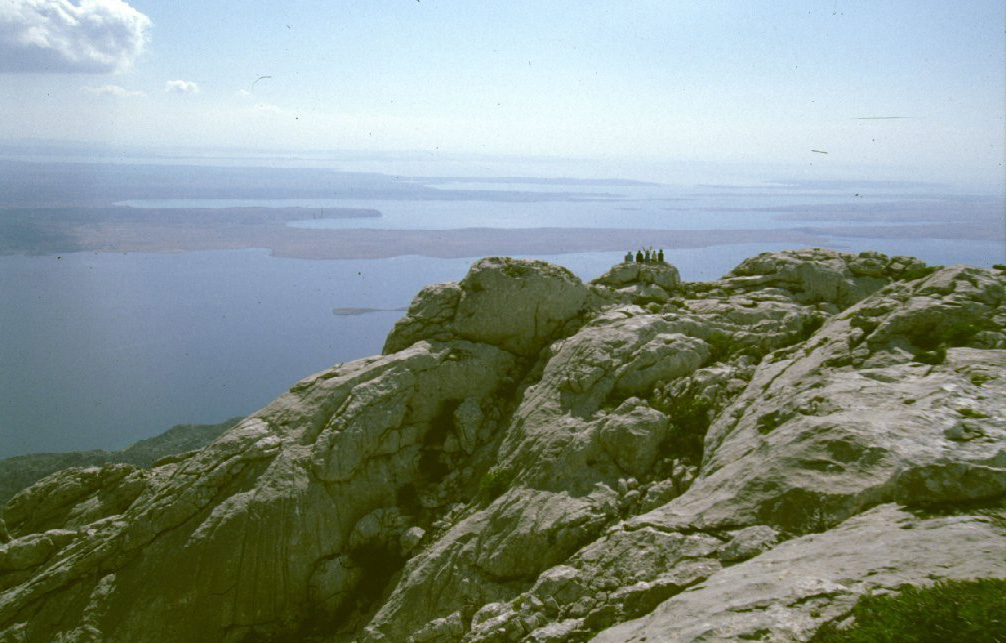
Legendary Velebit mountain near the Croatian coast, with spectacular view to the islands of Lošinj, Rab, and Goli otok
(photo by our dear friend, late Nino Marcutti, Zagreb)
Let us mention in passing
that the
oldest novel in the world about mountains
is Planine
(Mountains), written in Croatian by Petar
Zoranić in 1536 and printed in
Venice in 1569. It is also the
oldest Croatian novel. Petar
Zoranić, outstanding Croatian Renaissance writer, was born in Zadar in
1508.
Stipe Božić
Darija and Iris Bostjančić sisters, Milena Šijan, Ena Vrbek
Four Croatian female
alpinists climbed on Mt Everest
(8850 m) in 2009, among them two sisters Darija
and Iris Bostjančić,
besides Milena
Šijan and Ena
Vrbek. It was for the first
time that two sisters climbed on the top of Himalayas.
It was the 2nd Female
Croatian Expedition, led by Darko Berljak, which consisted of 11 girls.
The first expedition was successfuly organized in 2007 on Cho Oyu (8201
m), 35 km west of Mt. Everest.
American Football
Bill Bellichik and Nick Saban
Bill
Belichick & Nick Saban,
two Croatians - Coaches in the NFL (National Football League, USA), are
very successful with their teams playing american football. Let us cite
Bill Belichick:
"...I think it just makes this
division, which is already very tough, even that much tougher. You
know, two Croatians in the division, Joe, that's not something you see
everyday. [Laughter]..." (from
an interview given to Joe Benigno and Sid Rosenberg WFAN, sports Radio
66AM New York, January 5, 2005).
Garry GabelichBlue Flame, driven by Garry Gabelich Source
Vladimir Novak: Croatians
in America
Gary Gabelich,
USA Croat (his parents are from the city of Split), has won the world record
with his automobile "Blue Flame" in 1970, achieving the speed of 622.4
miles/h (i.e., more than 1000 km/h). Even more interesting is that this
record was unbeaten for as long as 13 years, see History
for kids, Utah, USA. In 1985 the Long Beach
City Council named a park in his memory, Gabelich
Park (near San Pedro and Los
Angeles).
Baseball
Roger Maris, Mickey Lolich
Famous Croatian baseball
players in the USA:
Roger Maris, baseball player, USA
Roger Maris
(1934-1985), major league baseball player,
was born in Hibbing, Minnesota the son of first generation Croatian
Americans.
Roger Maris (Maras) had a baseball record
in the USA which was unbeaten for as long as 27 years. See Roger
Maris Museum
and www.croatia.org.
George
Mikan (1924-2005), born in a
Croatian family in Illinois (his ancesotrs are from Vivodina near Karlovac,
in the region of Zumberak),
was
the best basketball player in the USA in 1944. He was the first
dominant "big man" in NBA, known as the "Gentle Giant" (208 cm, or 6
feet 10 inches). He was also one of the most effective scorers of his
time, averaging 22.6 points per game over his nine years long
professional career, with the then record of
11,764 points.
The Associated Press voted Mikan the greatest basketball player of the
first half of the 20th century. When Mikan's LA Lakers came to Madison
Square Garden, the marquee simply advertized "Tonight
George Mikan versus the Knicks!".
How basketball was played at that time, is indicated by the following:
he lost four teeth (in his first professional game), had two broken
legs, three broken fingers, broken wrist, broken nose and dozens of
stitches. Even some NBA rules have been changed because of his
superiority. George Mikan was named one of the NBA's 50 Greatest
Players in 1996 (on the occasion of 50 years of NBA), played four NBA
all-star games, and is in the Basketball Hall of
Fame.
For additional information see the Vladimir
Novak web page.
George Mikan, gentle giant
Sandy
Cecere,
2005: We have fond memories of George Mikan in my family. He was a
towering man with a big heart, and a faith in God that carried him
through many rough times. He needed a special car so that he could fit
into it. When he came to visit at our house he had to duck to get into
our house, and into our car, and garage. My father, a dear friend of
George was 5'8 inches tall, and George was 6'7" tall. When the two
stood next to one another, they were the true mutt and Jeff. George was
a man of great faith, and I know that Sam and George are in heaven
practicing law together, and talking about their love of sports. I will
always remember George Mikans smile and what a great friend he was to
my dad. When my dad was dying, Dad didn't want to see anyone, but
George didn't care, he came into the hospital to see his friend Sam,
and I remember my father's eyes lighting up, and that my Dad felt good
enough that day to have a long conversation with his friend George. In
my family we were taught to always call our elders, Mr and Mrs., so I
did. When I was in my 30's George told me to call him George. I told
him I just didn't think I could do that. He laughed and made me!! His
nickname for me was "the favorite one". I will always remember him.
Regarding
collective sports basketball is very
popular.
Important role for its development in Croatia
had Mirko Novosel,
both
as a basketball trainer and indefatigable organizer. He was inducted
into the Basketball Hall of Fame,
USA, in 2007.
Dražen Petrović and Mirko Novosel (photo from www.drazenpetrovic.com)Dražen PetrovićSource: Croatian
Philatelic Society, USA, founded
by Ekrem SpahicDražen Petrović, his monument in Zagreb
Monument to the memory of Dražen Petrović in his native city of Šibenik.
The city of Šibenik was founded in 1066 (11th century), during the
reign of Croatian King Krešimir.Krešimir Ćosić, Dražen Petrović, Toni Kukoč, Dino Radja
The best Croatian
basketball players were
Krešimir
Ćosić (1948-1995; he spent last
years of his life in the USA as
the Croatian diplomat); became
only the third international player ever elected to the world's Basketball Hall of Fame (in 1996)s
located in Springfield, Massachusetts, the
birthplace of basketball. See also his biography at KK Zadar.
Dražen Petrović
(you can see his beautiful monument in the Olympic park in Lausanne,
Switzerland), elected the world's Basketball
Hall of Fame
in 2002. He was very popular throughout Europe. Dražen Petrović:
Dino
Radja, inducted to the Naismith Basketball Hall of Fame in 2018.
Two best teams
are: Cibona
(Zagreb)
and the former Jugoplastika
(Split), which were several
times European
champions. Croatian national
basketball team won
the Olympic
silver medal in 1992 in Barcelona.
Rudy Tomjanovich
Rudy Tomjanovich, NBA player and coach of Houston
Rockets, twice NBA champion was inducted to Basketball
Hall of Fame in 2020.
Bowling
Nikola Dragaš
Nikola Dragaš, three times world champion in 9 pin bowling
Nikola Dragaš
was
three times indidvidualworld
champion in 9 pin bowling: in
Split 1972, Eppelheim 1974 and in
Vienna 1976. In 1988 he was the world
champion in pairs with Boris
Urbanc. He is one of the
greatest bowling players in history.
During the Serbian 1991-1995 aggression on Croatia he was
active
in humanitarian aid.
Since 2003 Nikola Dragaš leads the movement "With bowling
against smoking".
Boxing
Jimmy Lyggett
Jimmy Lyggett (1897-1955) was an
American boxer and trainer of Croatian boxing clubs in Zagreb, as well
as of Croatian boxing national team from 1939 to 1945. At the age of
20, he won the United States Championship for professional Black
boxers, while the next year he won the Colored Championship of the
World (light heavyweight). While he lived in Vienna, Austria, he met a
woman of Croat
descent, Roza, whom he married. The couple moved to Zagreb, Croatia in
the early 1930s. There, he opened his boxing school in Ilica street. At
the age of 33, he ended his career as boxer. He trained many young
boxers in several boxing clubs in Zagreb, starting with boxing club
Croatia, and later with clubs Herkules, Makabi and Radnik. After a
while, he became a friend with a neighboring tavern owner. He gave him
his warehouse in Preradovićeva as a training hall.
Jimmy Lyggett as a trainer of Croatian boxers in Zagreb. Source of the photo.
When the Independent State of
Croatia was formed, its Minister of Sports, Miško Zebić talked Lyggett
into training the Croatian national boxing team. He prepared the
Croatian team for the cancelled 1940 Olympics. Despite his race,
Lyggett was not interfered with by the Axis allied government of
Croatia.
Jimmy Lyggett on the right and Mijo Drvarić in the middle, champion of Croatia
and ex Yu (in 1940).
Lyggett was an anti-Communist.
Before the end of the war, his
brother invited him to return to the US. Finally he accepted the
invitation and convinced his wife to move to the US. In 1945, they set
off for the US via Italy. They waited for months the ship that would
take them to United States. His wife got ill and died in Milan. Broken,
Lyggett returned to America alone. His death place and death date are
unclear. Some sources say that he died in US in 1955. In Croatia, among
his friends he had a nickname "glista" (worm). Source of this text and
more
information at Wikipedia (and in
Croatian). A film about Jimmy Lyggetty has been shot by Oktavijan Miletić. See 2 min. video about Lyggett in Croatia. Many thanks
to Mr Tomislav Nürnberger, Zagreb, for his
kind information about Jimmy Lyggett.
Fritzie Zivic
We
should remember also Fritzie
Zivic (originally Zivchich,
1913-1984), known as The Croat
Comet, famous welterweight boxer
in the USA, who had 230 professional matches. In 1940 he won the title
of the champion
of the world having defeated
"unbeatable" Henry Armstrong. Their rematch held in Madison Square
Garden in 1941, where Fritzie managed to defend his title, was visited
by 23,190 people (and 5,000 fans were reportedly denied access). This
remains all-time highest Garden record for attendance. In 1993 entered
the "International
Boxing Hall of Fame".
For additional information see the Vladimir
Novak web page.
Fritzie Zivic, New World
Welterweight
Champion, The Ring, January 1941,
source Vladimir
Novak
In
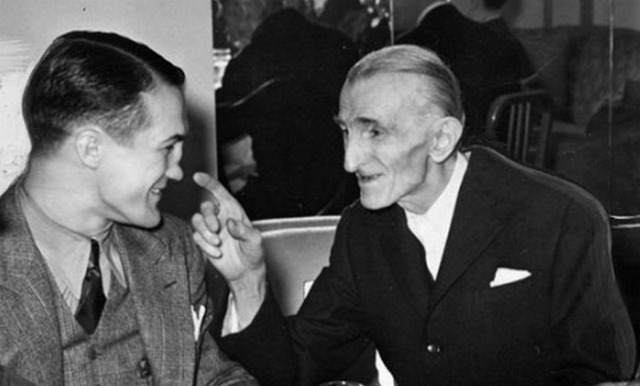
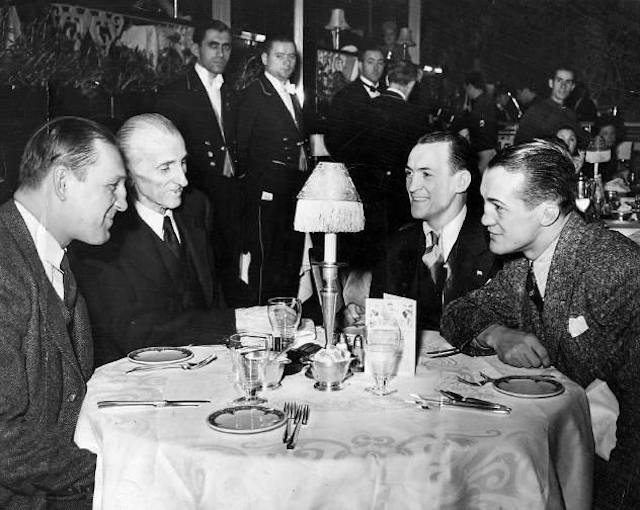
1941 Nikola Tesla,
distinugished Croatian-American inventor, invited Fritzie Zivic to the
lunch in New York,
as well as his brothers, after one of his successful defences of the
title of the welter-weight world champion.
Source newsinteractive.post-gazette.com, from the photo
archives of the Pittsuburgh Post-Gazette.
From left to right: Joe Zivic, Fritzie Zivic, Nikola Tesla, Jack Zivic,
Pete Zivic i Eddie Zivic.
Their father, Josip Živčić, was born in Bosiljevo in Croatia.
The
Croat Comet Fritzie
Zivic (originally Živčić) and Nikola Tesla
Fritzie Zivic was inducted to the International Boxing Hall of Fame in 1993. Nikola Tesla (2nd from
the left) with three of the Zivic brothers: Eddie, Pete and Fritzi (on
the right). Source.
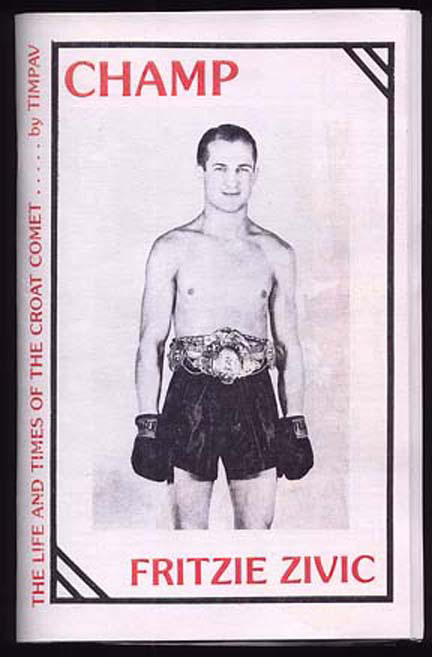
Several books were
written about his life (below is the front page of one of them, Timpav:
CHAMP - Fritzie Zivcic -
The life and time of the Croat Comet.
His four brothers were all boxers, and two of them, Pete and Jack
Zivic, represented the USA at the 1920 Olympic Games at Antwerpen,
Belgium. Jack won the Gold
medal for the USA in
featherweight category.
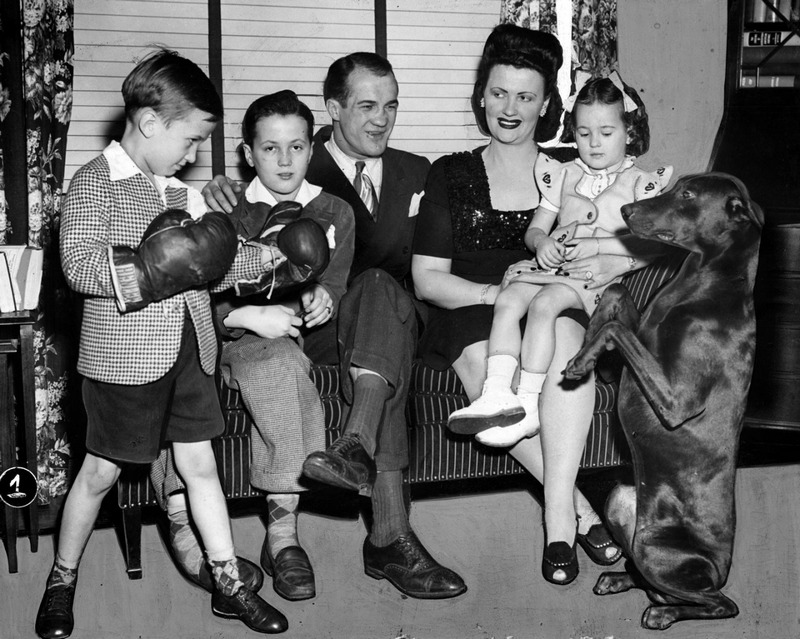
Fritzie Zivic, the Croat Comet, with his family in 1946.
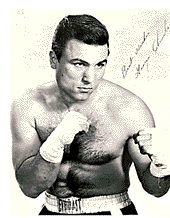
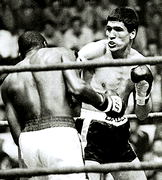
George Chuvalo
Another
well known name is George
Chuvalo (Jure Cuvalo), Canadian
Croat, heavy-weight
champion of Canada for more
than two decades (from 1958 to 1979), for as many as seventeen years
among the Top Ten professional boxers in the world, and never
knockouted.
He had matches among others with Floyd Patterson, Mohammad Ali (twice,
both times for the title of the world champion), Joe Frazier, and
George Foreman. His professional record is impressive: 79 wins (70 by
knockouts), 15 loses, and 2 draws.
Except being a world
class boxer, Chuvalo is known in Canada and in the USA as Anti-Drug
Crusader. This engagement came
as a result of a personal tragedy: he lost his two sons due to drug
overdose, the third one committed suicide, and his wife committed
suicide after that. Having remarried, he now tours Canada and the USA,
accompanied with his remaining son Steven, giving lectures for pupils,
students and parents, and trying to warn people about the danger of
drugs. He visited more than 300 schools, appeared in numerous movies,
tv shows, and is recipient of "Order of Canada" from Canadian
government for his hard work and dedication to Canada's youth. Please,
do not miss to visit
The above exceptionally
humanist and deeply moving web site obtained
the Golden Web Award for 2001
by the International Association of Web Masters & Designers.
In 2009 George Chuvalo visited the town of Ljubuski in Bosnia
and Herzegovina,
where his parents Stipe and Kate were born, and delivered an antidrug
lecture
for
youngsters.
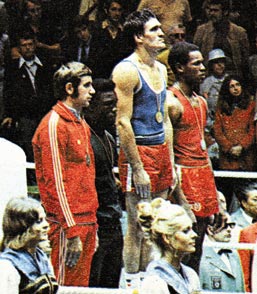
Mate ParlovMate Parlov, Olympic boxing
champion in
Munich in 1972
A light heavy-weight boxer Mate Parlov
(1948-2008) was was Olympic
champion in Munich, Germany,
in 1972, inaugural World
champion in 1974 in Havana,
Cuba, twice
European champion (1971 and
1973). In 1974 he started his professional boxing career. and
professional semi heavy-weight professional European
champion
in 1976, and professional
World champion (WBC) in 1978.
In his amateur career he had 310 matches with 13 defeats, while in 29
professional matches he had only 3 defeats.
Mate ParlovIvo Prebeg, Marijan Beneš
Ivo
Prebeg, a professional
heavy-weight boxer, was
the European
champion in 1969. Marijan
Beneš was
a professional European
boxing champion in 1979
(welter-weight category).
In 2003 Stipe
Drviš (Drews)
won the title of European semi-weight boxing champion. In 2007 he
became the light
heavyweight WBA champion of the world.
Filip Hrgović
Filip Hrgovic became super
heavyweight boxing champion of Europe in 2015. He was the Junior boxing heavyweight champion of the
world in 2010.
In 2026, Hrgović won the IBF heavyweight world title in boxing, in a match organized in London (O2 Arena). He became the first Croatian heavyweight boxing world champion.
Boxing - Thai, K1, MMF, bare knuckle, etc.
Branko Cikatić, Stefan Leko
A
world-wide reputation in thai boxing had Branko
Cikatić from Split, winner of
many international tournaments, including the grand 1994 K-1 Tokyo
tournament (see an interesting Brazilian
video about him). Also very successful in martial arts is Stefan
Leko.
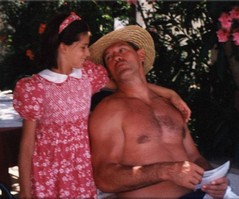
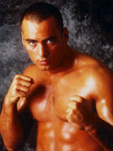
On the left: Branko Cikatić with his doughter. On the right: Stefan Leko.Mirko Filipović Cro-cop
Great successes in
martial arts has Mirko
Filipovic, known as Mirko
Cro Cop: K-1 Grand Prix '99
Finalist, I.K.B.F World
Heavyweight Full Contact Champion,
K-1 WORLD GP 2000 in Fukuoka Second Champion, winner
of the 2006 PRIDE
competition in Tokyo.
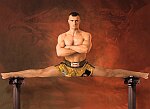
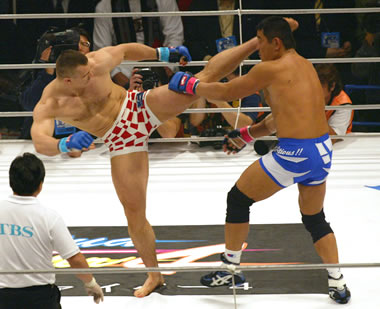
On the left: Mirko Filipović - Cro Cop. On the right: Mirko Cro Cop vs. Fujita, 2001, K-1 Tokyo, 70,000 spectators.Stipe Miocic
Stipe Miocic became the UFC World Heavyweight Champion in
2016.
Marko Martinjak
Marko Martinjak, Super Cruiserweight & Bridgerweight Champion
in BKB (bare knuckle boxing).
Chess
The oldest mention of Correspondence Chess
The first mention of playing chess in Croatia
dates from 14th century, more precisely, from 1385
in the city of Zadar. Thomas Hyde, an English orientalist from 17th
century, travelled through Croatia, and mentioned that the correspondence
chess had been played between
Croatian and Venetian merchants in 1650,
more precisely, beween the Dubrovnik
and Venetian merchants. It is the
oldest mention of the correspondence chess in history.
This fact can be found in his book "De ludis orientalibus" (On Eastern
Games), published in Latin in 1694.
In Croatia there are 162 registered players
of correspondence chess (30 of them active). Until the advent of
computers, chess moves were sent by snail mail, and sometimes one had
to wait for a few months for a single move. It is not surprising that
such a game could last for several years. Since 1990s the speed of the
correspondence chess has been revolutionarized due to the possibilities
of electronic communication, and its duration is comparable to that of
the "usual" chess game. Information by the courtesy of dr. Zvonko
Krecak, Croatian physicist, who is the president of the Croatian
Correspondence Chess Association
(Hrvatska udruga dopisnog saha) since 1987 (continuously till 2010 when
these lines are written).
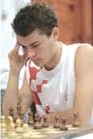
Ognjen
Cvitan, Croatian chess
grandmaster, earned the International Master title by winning the 1981 World Junior Championship
for competitors under the age of 20.
Chess Street in Croatia - unique in the world
In Croatia there is a Chess Street, the
only one in the world.
Aleksandar Lysenko, Russian international chess master, is the author
of an article "In the Chess Street" published by the well known Russian
chess journal "64 Chess Survey", Moscow 1996. The article deals with
the Chess Club in the Chess Street in the town of Ravna Gora in
Croatia. He wrote: "It is good that such a street exists, but it is a
pity that the street is not in Russia."
Valentina Golubenko and Ivan Šarić
Valentina Golubenko and Ivan
Šarić won the titles
of world
youth chess champions for
2008 in the category up to 18 years, at the competition organized in
Vietnam. With two gold medals and one bronze, Croatia was ranked third
at the World Competition, after India and Vietnam, and before China,
Russia, USA, Germany etc.
Ivan ŠarićIvan
Šarić, world chess champion for
2008 under the age of 18,
with Croatian Coat of Arms
In 2018, he won the European Individual Chess Championship, and became the second player from Croatia who managed to achieve this title after Zdenko Kožul, who has won it in 2006. Here, the notion of "European" does not mean just EU, but includes GB, Scandinavian countries, Switzerland, Ukraine, Russian Federation, Georgia, Azerbaijan, Armenia, and Israel!
During the 2014 Chess Olympiad, he managed to defeat Magnus Carlsen.
We feel it necessary to
mention Gari Kasparov,
a famous Russian chess player, former champion of the world. He
played as a member of chess teams of Vukovar (in exile from 1991 to
1998) and Sarajevo. Upon his request, Gari Kasparov has been
granted Croatian
citizenship in February 2014.
Crossbow
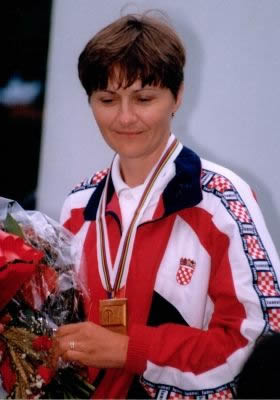
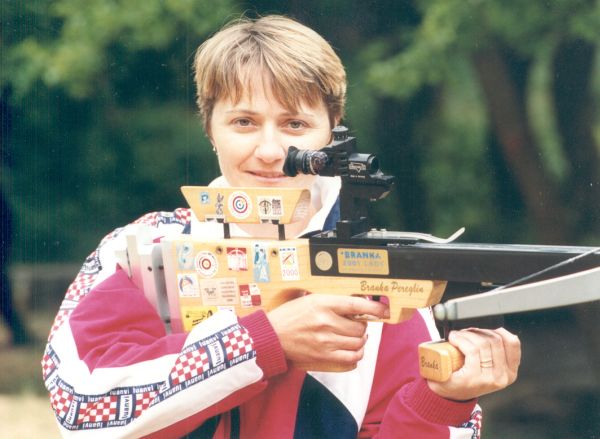
Branka PereglinBranka Pereglin
Since 1998. Croatia had
outstanding results in crossbow
competitions, especially for
ladies. One of the best competitors of the world for ladies is Branka Pereglin.
She was:
eight times European champion:
in 1995 (Portugal), 1997 (Portugal), 1999 (Croatia), 2001 (Czechia),
2005 (Holland), 2007 (Russia) at outdoor competitions, and in 2003
(Belgium) and 2005 (Russia) at indoor competitions on 18 meters,
from 1995 to 2007 she
participated on all European championships, and won
gold medals on all of them!
four times world champion:
in 1996 (Taiwan), 1998 (Hungary), 2002 (Croatia), in 2004 (Czechia),
and world vicechampion of the world in 2000 (New Zealand) and 2006
(Austria). She set seventeen
(17) world records, and
equalled one.
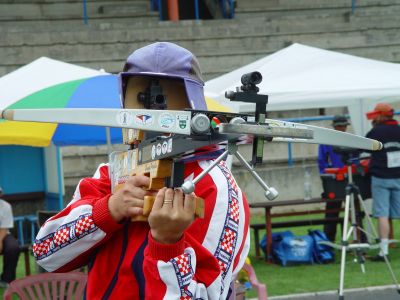
Branka
Pereglin, a famous Croatian
crossbow shooter, in total concentration...
Note her nice dress decorated with well known motive from Croatian Coat of Arms.
It is amazing that in
2004, during the European Crossbow Championship in Czechia, the
Croatian female
team
(Branka Pereglin, Nikolina Krivanek, and Sanja Komar) surpassed the best
male team (France) by 85 points!
Discus throwing
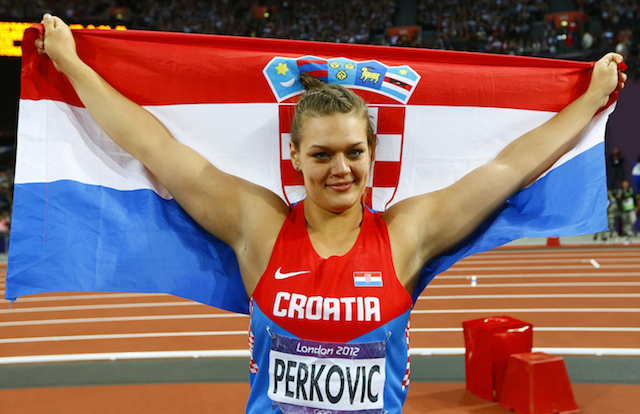
Sandra Perković
Sandra Perković,
discus
thrower, was only at the age of 19
when she won
gold medal at the European
Athletics Championships
Barcelona 2010. She became the youngest
ever winner of discus throw competition among woman. In 2012,
during the Summer Olympic Games in London, she won Olympic women's discus title
with a Croatian
national record throw of 69.11m, in front of girls from Russia and
China. In the
2012 European Championships in Helsinki she won gold medal.
In 2013 she becam
the world
champion in
discus throw, during the World Attheltics Championship in Moscow.
In
2014 she won the title of European
champion in discus throwing
in Zurich, Switzerland, in 2014. It
was her THIRD consecutive title of European
champion, and
this fact is unique for this sport. Her winning throw was more than 71
meters. Three of her other attempts at the competition would also have
sufficed for the gold medal. The winner of the silver medal
representing France had more than 5m weaker result, which shows the
dominance of Sandra Perković in this sport. This is one of the greatest
achievements in the history of Croatian sports.
Sandra Perković, Giovanni Černogoraz at Olympic Games in London 2012
Martin Marković
became the second Croatian male
athlete to win a world junior title
(2014) and the first one in 12
years with a world-junior-leading 66.94m in the discus final at Hayward
Field. It was his first global medal after four appearances
in
World Youth and World Junior Championships finals. Markovic’s
gold was Croatia’s second medal in Eugene after Sara Vlašić
took
the silver in the javelin.
Croatian quad scull won
silver medal,
Lucija Zaninović won bronze medal in tae-kwon-do, handball team also
won bronze medal. An unofficial gold medal went to Antonija
Mišura, see why.
Diving (platform)
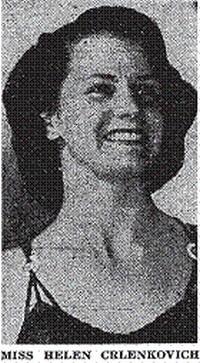
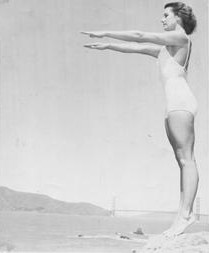
Helen Crlenkovich
Helen Crlenkovich
(1921-1955) was one of the most successful athletes in America and the
world on the three-meter springboard and the ten-meter platform. She
was an American-born Croatian lovingly known as "Klinky." Her best
sports years began in the late 1930's. She not only became the best
American, but also the world springboard and platform diving champion.
She was the first female to do a full-twisting 1 1/2 somersault and
several other dives that were heretofore only achieved by men. Helen
was chosen to represent America in the 1940 Olympic Games. All
concerned felt that Helen would achieve two gold medals as a minimum.
However, because of the onset of the Second World War, the games were
cancelled. She was also honored by being inducted into the Helms
Foundation Diving Hall of Fame in California. In September 2008, Helen
received post-mortem recognition by the World Acrobatic Congress held
in Las Vegas for her life achievements in swimming and diving. She died
very young out of cancer. Her both parents are from Croatia: mother
Anka Tomin is from Petrijevci, and father Adam from Banicevac. (Text by
dr. Ante Chuvalo, Chicago).
An interesting note as regards Helen is the
fact that her trainer, Phil Patterson, insistently urged this young
Croatian-American woman to change her name to something that is "more
suitable." He told Helen that with a name like Crlenkovich, she will
not achieve any hoped-for success. Nonetheless, Helen, just as
insistently, rejected his suggestion because she was proud of her
Croatian name and heritage. This fact speaks volumes as to the strength
of her character.
Figure skating
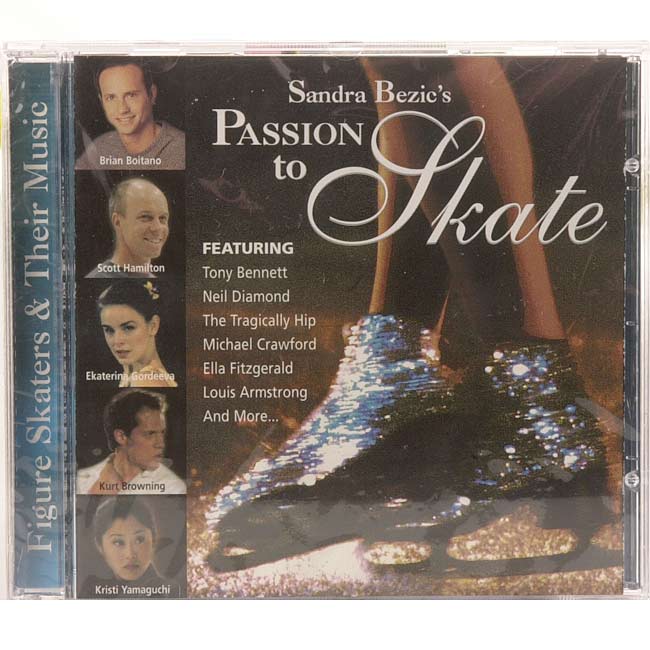
Val and Sandra Bezić
Val
and Sandra Bezić, brother
and sister, are famous Canadian figure skating pair. They were champions of Canada
in the period of 1970-1974, and representatives of Canada in the Winter
Olympic Games, Munich, 1972 (placed ninth). Sandra Bezic is known as
one of the best figure skating choreographers in the world. For many
years, Bezic served as producer, director, and choreographer of the
touring show Stars on Ice. Sandra Bezic also worked on highly acclaimed
"Carmen on Ice." She designed programs for Olympic champions Brian
Boitano and Kristi Yamaguchi, and wrote the book The
Passion to Skate, which was
made into a documentary. Bezic also choreographed the routines of
figure skaters Kurt Browning, Josée Chouinard, and Katarina
Witt for 1994 Olympics.
Football (soccer)
Soccer beginnings among Croats
In 1880, local Croatian young men
began to play football in Županja,
a small Croatian town near Danube river. Since there were only nine of
the Englishmen who came to Croatia several years before, they invited
local boys to join them. In 1914, professional coaches from England
came to Croatia. James Donelly and Arthur Gaskhell, who were the
coaches in "Gradjanski" club in Zagreb that in 1936 defeated famous
Liverpool with the result of 5:1, are certainly worth mentioning.
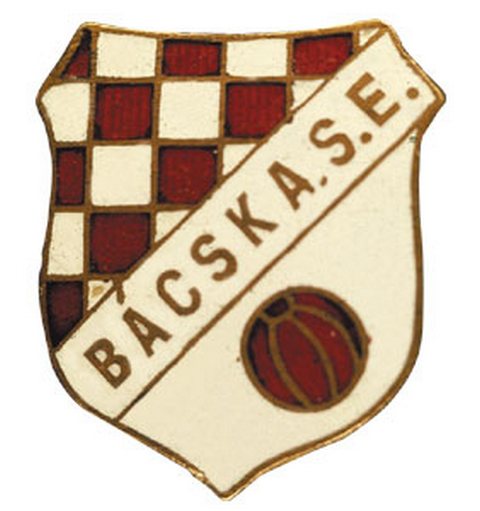
The oldest Croatian
soccer club is Bačka,
founded in Subotica in Bačka
in 1901, playing in the then Croatian league. It is also the oldest
soccer club in this part of Europe.
The first international
football (soccer) match where Croatia participated with its national
name had been held in 1907 (with Czechia). The Croatian
Sporting Union was founded in
Zagreb in 1909. In 1911 the Croatian representation participated under
its flag (and with its national name) on the European championship in
Torino. In 1912 Franjo Gregl
was the European
champion in bicycling.
Ante Žanetić, a member of world's best soccer team in 1960,
along with Pele, DiStefano, Puskas etc.
The ex-Yugoslav soccer team won the Olympic
gold medal in Rome in 1960.
The same year, Croatian soccer player Ante
Žanetić
(1936-2014), was
elected by World Soccer
(London) as a member of the world's best eleven, along with Pele,
DiStefano, Puskas, Gento, Julinho, etc. Also in 1960, he participated
at European championships in Paris, winning silver medal. In 1967, he
emigrated to Germany, and died in Australia. In 2006 he wrote an
autobiographical book Zlato Rima i
Srebro Pariza (The Gold of Rome
and Silver of Paris). Jakov Sedlar, distinguished Croatian filmmaker,
produced a 30 min biographical film about Ante Žanetić.
Miroslav Ćiro BlaževićCroatian fans in France, Coup du Monde, 1998
No doubt, the greatest
success achieved by Croatian soccer is the third
place at 1998 World
Championship (Coup du Monde)
held in France. The excellent team of Holland was defeated by 2:1 in
the match in Paris. Thus Croatian team became the greatest surprise of
the Championship. Our national team has been led by Miroslav
Ćiro Blažević (Bosnian Croat
born in the town of Travnik).
Miroslav Ćiro Blažević, Coup du Monde, France, 1998Davor ŠukerDavor
Šuker, member of Croatian representation, Coup du Monde, France, 1998. Golden
Boot Winner.
Many Croatian sportsmen, trainers and others are well
known throughout Europe.
As an example, let us take the city of Sevilla
in
Spain only (1995):
Aco
Petrović (brother of Dražen
Petrović)
was a trainer of a basketball club in Sevilla and, last but not least,
Vjekoslav Šutej
conducted the Royal Philharmonic
Orchestra in Sevilla from 1990 to 1996 (better known as conductor of
annual Christmas concerts in Vienna).
Warning
In the summer of 2005 a
qualifying soccer
match between Hungary and Croatia was held in Budapest for the World
Competition in 2006, when Croatian team already had secured the first
place in their group. Within Croatian fans there was unpleasant
disorder, which according to Vlatko Markovic, president of Croatian
Soccer Association, has been organized in advance in order to discredit
Croatia. Namely, a group of alleged Croatian fans with Croatian design
came to the match from a part of Serbia inhabited by Croatians. See his
interview to Hrvatska rijec,
Subotica, October 2005, No 141, p 57.
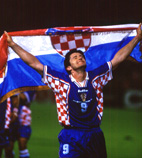
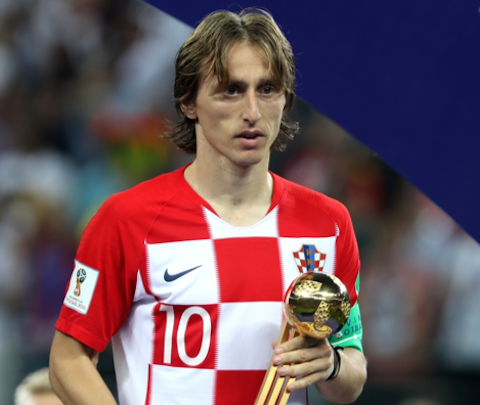
Zvonimir Boban, Luka Modrić, Ivan Rakitić, Dejan Lovren
In 2018, Croatian achieved its greatest success in football -
silver medal at the FIFA World Cup (orgnaized in the Russian
Federation), surpassing the 1998 success of winning bronze medal at the
FIFA World Cup (organized in France). We recall the names of Davor
Šuker, Zvonimir Boban and Slaven Bilić
from 1998, and the names of Luka
Modrić, Ivan Rakitić and Dejan Lovren in 2018. See here:
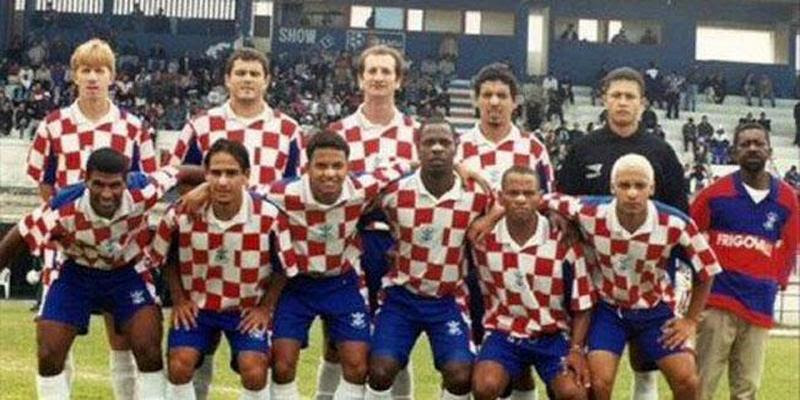
In addition to this, due to information provided by maestro Frano Kakarigi (distinguished Croatian classical
double bassist working in Granada, Spain, born in the city of Dubrovnik), we know of a
Croatian football tema wearing Croatian jerseys:
In
2007 Croatian football team led by Slaven Bilić defeated England in
London in a qualifying match for Euro 2008, in front of 88,000
spectators. According to English media, it was the greatest display
from a visiting nation to Wembley in modern times. Also, it was the
first time a country had scored three against England in a competitive
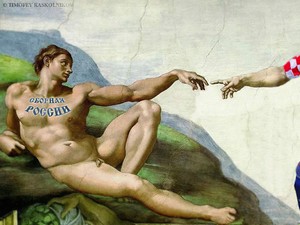
game at the venue since 1972. This victory was crucial for the Russian Federation to
qualify for Euro 2008, see Thank You Croatia! Spasibo Horvatiya!
Soccer is of course the
most widespread sport. An excellent soccer club in Croatia is Hajduk
(from the city of Split), founded in 1911 (by Croatian students in the
Prague, Czechia,
in the well known beerhouse "U Fleku") three times
quarter-finalist of the European League of
Champions (last time in 1995) and once a semi-finalist of the UEFA cup.
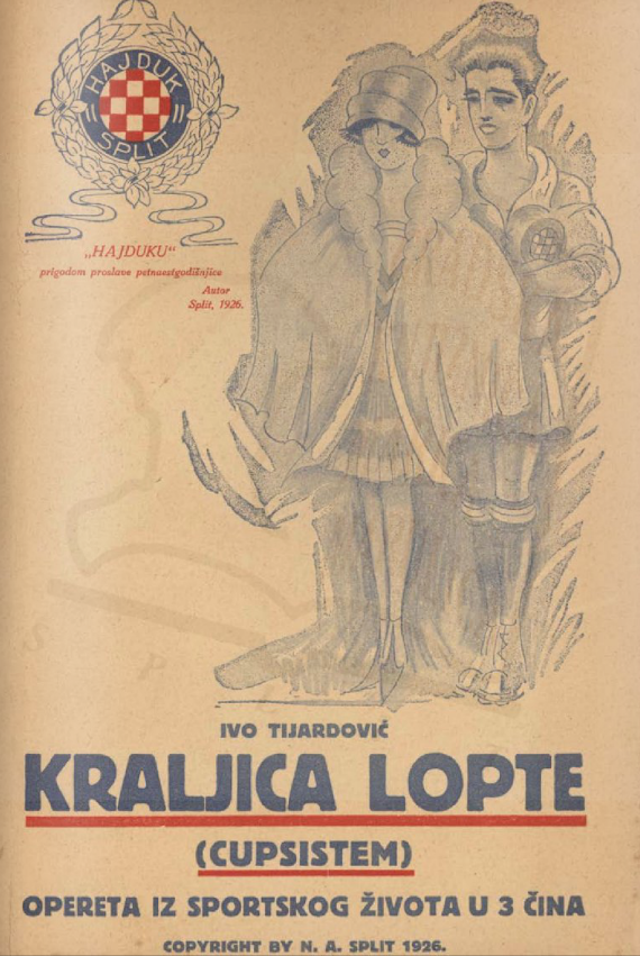
Ivo Tijardović: Kraljica lopte
(Queen of the Ball),
Split, 1926.
Hajduk is the only soccer club in the world which has its own operetta,
composed already in 1926.
Many thanks to Dr Lea Botteri, University of Zagreb, for her kind
information.
Dedication by the author, Ivo Tijardović, distinguished Croatian
composer, in Split 1926,
on the occasion of the then 15th anniversary of the soccer team of
Hajduk (founded in 1911).
Hajduk is the only soccer team in the world which has its own
operetta (Kraljica lopte,
i.e., Queen of the Ball),
already since 1926. It has been composed by Ivo Tijardovic,
distinguished Croatian composer.
Alen Bokšić - "Fantastic player, fast, physically strong and technically gifted; I've always considered him as one of the best strikers in Europe" (Bryan Robson).
Dinamo - Zagreb soccer club
The champion
of the Tournament of Cities
(the future UEFA cup) in 1967 was "Dinamo", winning against Leeds
(England) in the finals.
Croatian soccer clubs worldwide
A traditional 36th tournament of Crotian
soccer union in Canada and the USA in 1999 included the following clubs
with indicative names:
CROATIA Florida, CROATIA Toronto, HRVAT St.
Catharines, CROATIA New York, Croatia Mississauga, CROATIA Windsor,
CROATIA Detroit, DALMACIJA Streetsville, CROATIA Norval, NERETVA
Mississauga, CROATIA Cleveland, ADRIA Subrury, LIVNO Oakville, CROATIA
Hamilton, ADRIA Oshawa, CROATIA London, CROATIA S.S. Marie, HRVAT
Kitchener, VELEBIT Oakville, HRVATSKI Orlovi Milwaukee, HRVAT (ZRINSKI)
Chicago, CBP JADRAN Chicago, JADRAN Ottawa, KARLOVAC Mississauga,
ZAGREB Toronto. HRVAT Kitchener has won the the first place. Believe it
or not, there are more than 100 (hundred) soccer clubs outside of
Croatia, throughout the world, bearing the name of Croatia.
Mr. Charles
Perkins (1936-2000) was the
first Aborigin in the history of Australia who earned the university
diploma. Later he became the political leader of Aborigins. It is worth
knowing that as a young man he played soccer for the Adelaide Croatia
Soccer Club since 1958. In his autobiography he reflected with fondness
on his friendships with Adelaide
Croats
and other immigrants he met through the club.
Diego Maradona
It is little known that Diego
Maradona, Argentinean soccer player, had a great-grandmother which
was a Dalmatian Croat. One of his daughters bears the unique name
- Dalma!
I owe this information to the King
of Dolls.
Tomas Felipe "Trinche" Carlovich
Tomas Felipe "Trinche"
Carlovich, of Croatian origin, is considered to be one of the
greatest Argentinean football players. More information: info1,
info2, info3,
info4.
Futsal
Futsal 2024 champions in Shanghai
The University of Zagreb futsal team represented
Croatia at the FISU World University
Futsal Championship
in China which was held from 10th to 16th June 2024 in Shanghai. After
advancing through the group stage, a 4:1 victory was achieved in the
quarter-finals against the Portugal team, followed by a 4:2 win against
Ukraine in the semi-finals. In the final match against Brazil our boys
beat a team full of top international players 4:1 and deservedly became
world futsal champions. Watch
the final match between Croatia and Brazil. Bronze medal for Croatia during the European Futsal Championship 2026
Bronze medal for Croatia during the European Futsal Championship 2026, defeating France in play-off. The competition includes not only the countries of EU, but also many other.
Freediving
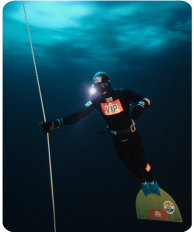
Kristijan Curavić
Kristijan
Curavić set a new world record
in diving under ice (2004). He reached a depth of more than 50 meters
under ice (1.4 m thick) in Lake Djupvatnet (1100 m above sea level) in
the Northeastern part of Norway, wearing only a mask, wetsuit and
monofin.
In 2005 he improved his own record
reaching an amazing depth of 51.2 m in 1.32 min., at the temperature of
air of -22 degrees C, and water temperature of -3 degrees C, while the
ice was 2m thick.
After this exploit (which is not recognized by international diving
organizations
due to extreme life danger), Kristijan said: "This is a great event for
me and
for Croatia". For
more
information
see www.curavic.org.
Karla Fabrio
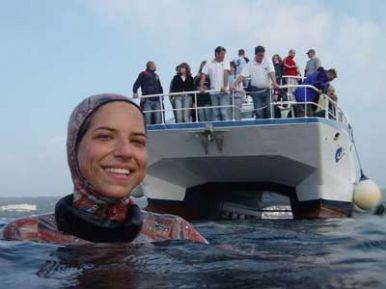
In
2007 Karla Fabrio,
a Croatian representative, set up a world record
in diving on breath for women (discipline Jump Blue), on the World
Championship held in Bari, Italy, attaining 130 m. In this way she
equalled her own world record attained earliear the same year in
Croatia, on the island of Vis.
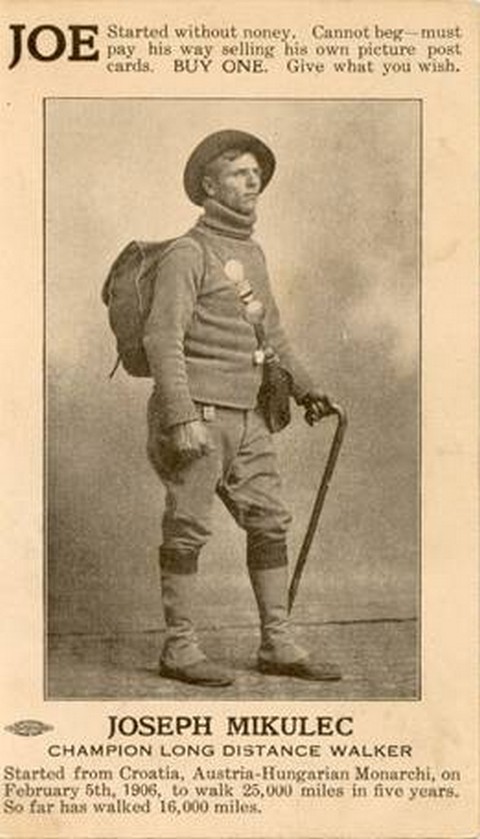
In 1898, at the age of
27, Croatian explorer Mirko Seljan
walked 2800 km
from St. Petersburg (Russia) to Paris (France), in just 110 days. In
this way, he earned the title Champion Globetrotter. However, the
greatest Croatian globetrotter (and probably of entire History) was Josip (Joe, Joseph) Mikulec.
Croatian
adventurer Josip (Joseph) Mikulec
set out to circumnavigate the globe on foot in the span of five years.
With the start of this journey he became a perpetual wanderer. Mostly
hiking, he traveled the world some 28 years and achieved a degree of
fame for having collected more than 30,000 autographs of world-famous
people. He was also called hyperpedestrian.
Mate Šimunović
Another Croatian hyperpedestrian was Mate
Šimunović (visiting about 70 countries), about who a very interesting
monograph was published (in Croatian), based on his preserved diary:
Stipe Božić i Drago Glamuzina (eds.): Mate Šimunović Ja, Mate Svjetski (Summary),
Zagreb 2013. Video
Golf
Golf club in Zagreb
In 1331, the first golf-club in Croatia has been founded in the city of
Zagreb. The same year (June 12th, 1931), the first golf tournament in
Croatia has been organized in the beuatiful Maksimir Park in Zagreb. The patron of the
tournament was Queen Mary
of the United Kingdom, who was also present at the tournament.
Source Zvonimir Milčec: Galantni
Zagreb, Mladost Zagreb 1989. (2nd edition), p. 237.
Gymnastics
Augustin Jaromir Löffler
Augustin Jaromir Löffler (1832-1915), born in Czechia, the author of the first
gymnastics textbook in Croatia, published in Zagreb in 1879.
The first gymnastics textbook in Croatian language was
published in Zagreb, 1879, by Augustin Löffler (entitled Gimnastika za učitelje pučkih učiona i
učiteljske pripravnike, 154 pp). Born in Czechia in 1832 (in
Jindřichův Hradec),
he arrived to Rakovac (now a part of the city of Karlovac) in 1870. He
was one of the teachers of Nikola
Tesla during his schooling in Croatia, at the Higher Real School in
Rakovac (now Gymnasium in Karlovac). For more information about Augustin Löffler, see Ivica Vuković i Anđa Valent: Autori matematičkih rasprava u izvješćima rakovačke realke, Prirodoslovlje 2016, str. 89-110.
Augustin Löffler: Gimnastika za učitelje pučkih učiona i
učiteljske pripravnike, Zagreb 1879
The first gymnastics textbook in Croatian language.
HAŠK - Croatian Academic Sports Club, Zagreb
Students of Zagreb
University founded the first sports
society in Zagreb called "HAŠK" (Hrvatski Športski Akademski Klub - the Croatian Academic Sports Club),
already in 1903.
It is little known that our eminent chemist and recipient of the Nobel
Price for chemistry in 1975, Vladimir Prelog,
was a "HAŠK" athlete and the first Croatian champion in the modern
pentathlon in 1923!
Nikola Matković and Đuro Stantić
Nikola
Matković (1864-1946),
living in Subotica, was a very successful athlete in the then
Austria-Hungary. When the Subotica Gymnastic Society (Subotičko
gimnasticko drustvo) competed in Belgrade in 1900, they won the first
prizes in all disciplines. Furthermore, the newspapers reported that
"...the Subotica sportsmen demonstrated in Belgrade the new game called
Football, until then unknown in that city..." One of Matković's pupils
was Đuro Stantić,
the world
champion in walking on 75 km,
in Berlin
1905.
See Ante Zomborović: Nikola
Matković prvi Hrvat-Bunjevac školovani učitelj tjelesnog odgoja,
Subotička Danica (nova), Kalendar za 2004, Subotica 2003, pp 192-194.
Beginnings of soccer in Croatia
by Croatian Football Federation.
The Documentary film "Toronto Croatia - Great Croatian
Story...", from
Screenwriter Hrvoje Hitrec, Director Jakov Sedlar and Producer Josip
Pavičić captures and for the first time presents the great and
unrepeatable Historical documentation. All important
witnesses of
these Historical accomplishments of Eusebio, Grnja, Bradvić, Bilić,
Kenfelja, Ante Pavlović, Šimunić, Šuker, Niko Kovač, as well as Robert
Iarusci, Bruce Thomas, and Ante Pavelić, testify to this unified and
unique team. In 1976 Toronto
Croatia won the Continental
Championship
with as many as 20 consecutive wins and became the champion of the North
American League.
Filip Ude, Jana Košćak
Filip Ude
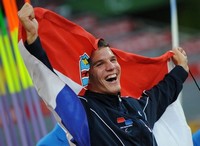
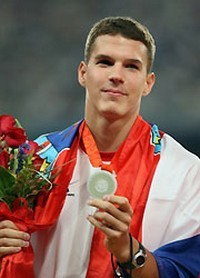
won silver medal in pommel horse at the 2008 Olympic Games in Beijing.
It was the first gymnastics medal for Croatia on Olympic Games.
Jana Košćak won the U20 heptathlon gold medal in Lima at the
World Athletics U20 Championships Lima 2024
World Athletics. Interview (in English, by Hannah England); interview
(in Croatian, by Dubravko Šimenc), both in 2023.
Tin Srbić
Tin Srbić won silver medal for Croatia in
gymnastics horzontal bar in Tokyo 2021.
The following photo is one of the most amazing in the history of Croatian sport (representing flags of Croatia, China, and Japan):
Tin Srbić of Croatia winning the gold medal in gymnastics, high bar, Antalya Wolrd Cup, 2025.
2025 Antalya World Cup High Bar Medal Ceremony.
This is one of the greatest achievements in the history of Croatian sports.
Handball
Velimir Kljaić, Lino Červar
Our
basketball,
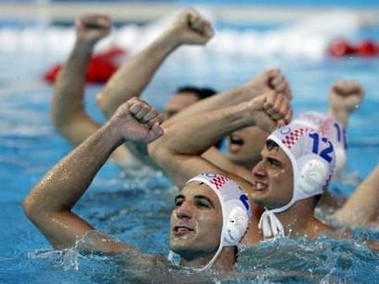
water polo and handball teams were in some periods among the
best teams in the world. They won many gold medals on
the Olympic and World championships. Our water
polo
team won
silver medal at the Olympic games in Atlanta, 1996
(gold medal for ex-YU at the Olympics in Ciudad de Mexico in
1968, the team had 12 players,
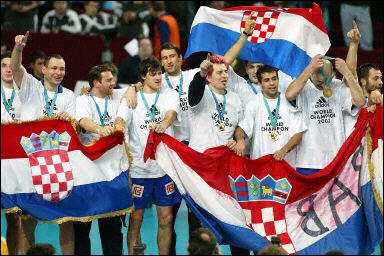
out of them 8 were Croats). The Croatian
handball team won
the olympic gold medal
in Atlanta in 1996, under leadership of Velimir
Kljaić,
gold medal at the World Championship
held in
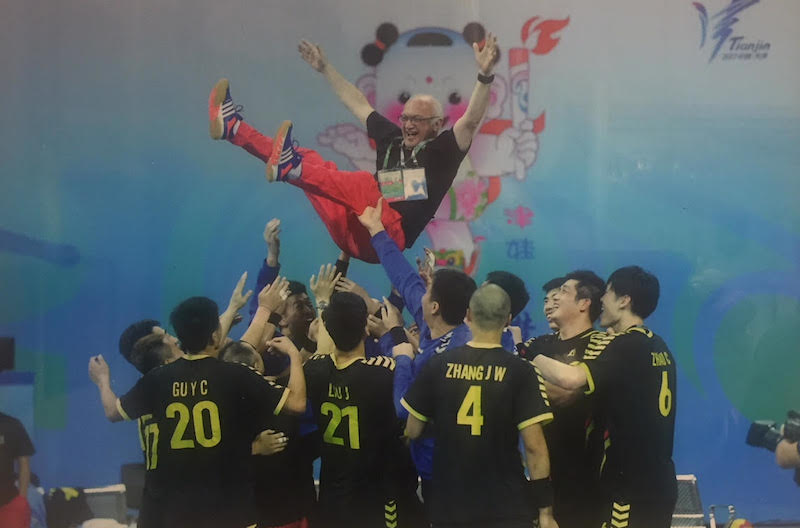
Portugal in 2003, under the baton of Lino Červar
the olympic gold
medal in Athens in 2004 with perfect score,
without any lost game, under the leadership of Lino
Červar
(for the first time in the history of this sport the same
national team
bears the titles of both Olympic and World champions).
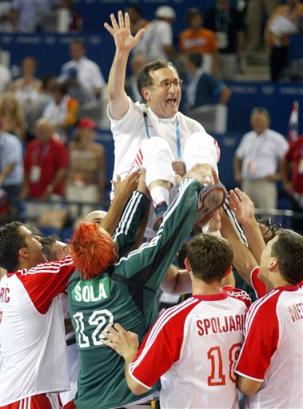
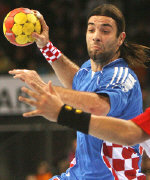
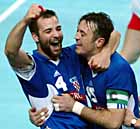
Croatian handball triumph in 2003, PortugalCroatian handball triumph in Athens, 2004, Lino Červar on hands of his team (AP Photo/Alastair Grant)I warmly recommend You the following book
(in Croatian):
Lino Červar: Od Učke do Olimpa,
Teovizija, Zagreb, 2004., ISBN 953-209-084-3
La
Croatie est championne du monde de handballIvano Balić
In
2004, when Croatia won the
second Olympic handball title
in Athens (after the first one in 1996, Atlanta), Ivano
Balić was proclaimed the best handball
player of the world
for 2003 by International Handball Federation.
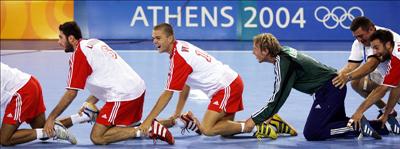
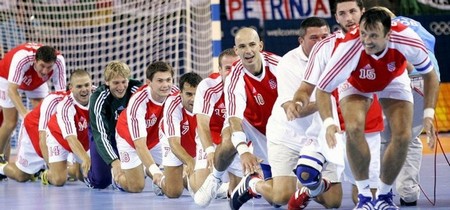
A
famous "Croatian worm" - handball players celebrating gold medals
(Reuters)
At the 2009 World
Handball Championship organized in Zagreb Croatia won silver medal,
which was another great success our team. World
Cups History.
In 2009 Croatia became
the new
world champion at Men's Youth World Championship
in Tunisia.
In 2010 Croatia handball team won silver medal. It is interesting that
in the period of 2000-2010 Croatian team was 9 times in the finals of
the European championships. No other country in Europe had such a
continuous series of top results.
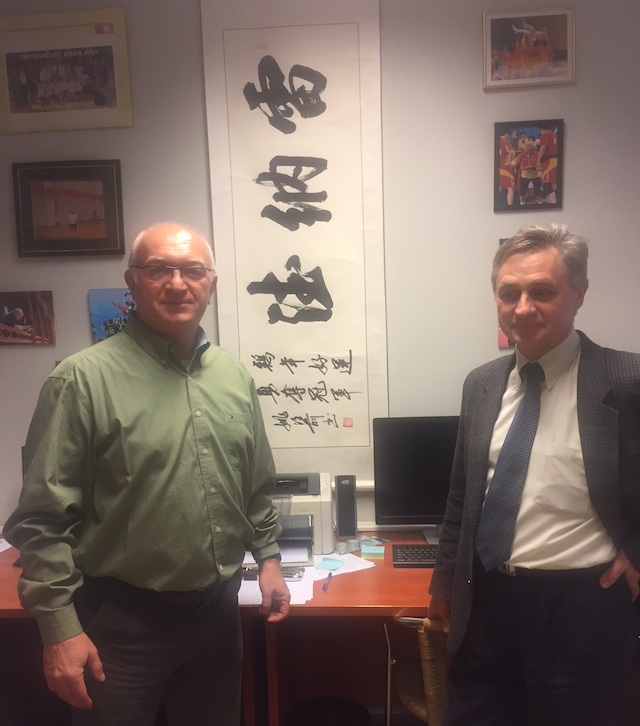
Nenad ZvonarekNenad Zvonarek, handball trainer in China Professor Nenad Zovnarek in his
office at the University of Zagreb, with Professor Mario Cifrek
Blanka
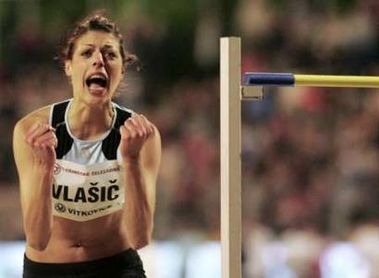
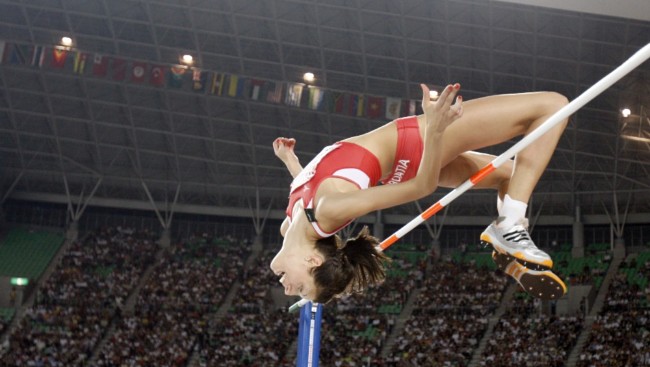
Vlašić, high-jumper, with her
record jump of 2.07 (the second best in history, 2007), was Junior World Champion twice
(Santiago, Chile, in 2000; Kingston, Jamaica, in 2002), and champion of
XIVth Mediterranean Games in Tunisia, 2001.
In 2007 she won the gold
medal in Japan at the World
Championship in Athletics,
Osaka 2007. This is the first
gold medal for Croatia in World Championships
in Athletics, and one of the greatest successes in the history of
Croatian sport. In 2008, at the Bejing Olympic Games, Blanka had
another great
international success: she won silver medal. Before that she had as
many as 34
consecutive
wins at international competitions in the course of 14 months.
At the Golden Spike IAAF World
Athletics
Tour Meeting in Ostrava, Czech Republic, Branka Vlašić won with a jump
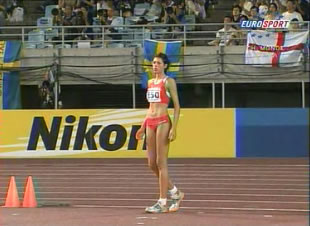
of 2.00 meters (photo by REUTERS/David W. Cerny). Winner of the 2007 Atheltic
tournament in
ShanghaiBlanka Vlašić in Gothenburg,
Sweden (Getty
Images)World Championship in
Athletics, Osaka
2007. Endelig lyktes det for kroatiske Blanca
Vlašić i et mesterskap. I Osaka
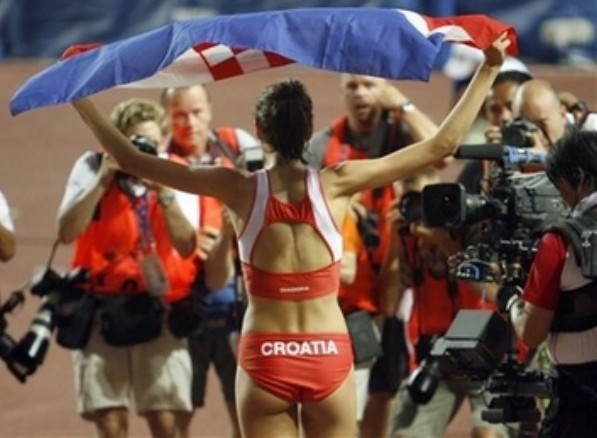
ble hun dronningen av hoyde.Blanka Vlašić celebrating her
victory with
Croatian flag in her hands,
at the World Championship in Athletics, Osaka 2007, source CROWN
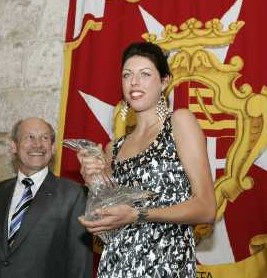
World High Jump
champion Blanka Vlašić of Croatia with her
trophy
after receiving the Waterford Crystal European Female Athlete of the
Year Award for 2007 (on the left the President of European Athletics,
Hansjorg Wirz) during a gala dinner at the Mediterranean Conference
Centre in Valletta, Malta, October 12, 2007. Photo by Reuters.
Blanka Vlašić won the
title of the champion
of the world in Berlin 2009
for the second time after Osaka 2007. In 2009 she reached the height of 208 cm
at the Hanžeković Memorial Athelic Competition in Croatia's capital
Zagreb, which was the second best result in the history of high jumping
for women.
In 2010 in Doha, capital
of Dakar, Blanka Vlašić won her fourth
consecutive
gold medal at World
Cahmpionships,
as the first female competitor in history.
Croatia
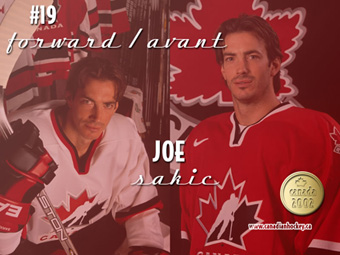
has no tradition in hockey. However, one of the greatest hockey players
of today is Joe Sakic,
Canadian Croat. His both parents are from Croatia (his father is from
Imotski, and mother from Lika).
Joe contributed greatly to the final victory of
Canadian
national team at the 2002
Winter Olympic Games held in Salt Lake City.
Joe Sakic (photo from www.canadianhockey.ca)
Two outstanding hockey players of Croatian Origin were brothers Frank
and Peter Mahovlich.
Frank is now a Canadian Senator and a member of the Hockey Hall of Fame.
Many thanks to Mr. Wally Cencich for this information.
Horse racing
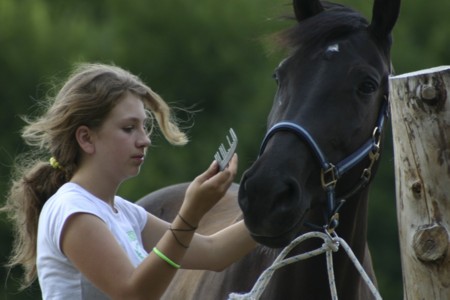
HorsesLucija in the village of
Potkonje near
Knin, at Hrvoje Požar stud.
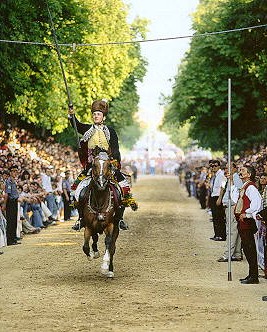
Photo by her mother Julija Vojković (on this web with kind permission)Sinj Alka
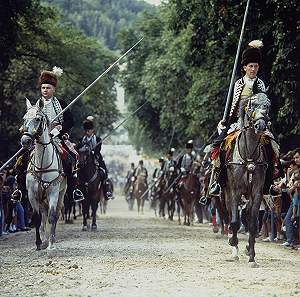
Sinjska
alka (The Sinj Alka) is a
competition to the memory of the legendary 1715 victory over the Turks,
where the town of Sinj near Split has been saved. According to the
legend, the victory was attained due to the help of the Lady of Sinj
(Gospa Sinjska). The aim of the competition, organized August 15th each
year since 1715, is to pierce the ALKA with a spear, riding a horse at
full speed (45 km/h). The alka is hanged on the rope at the hight of
3,22 m.
Photo by Julija Vojković (on
this web with
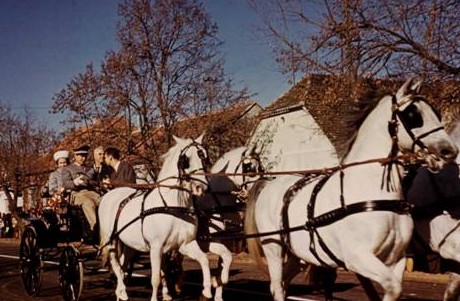
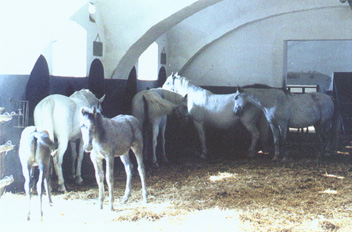
her kind permission) Đakovo stud, Lipik lipizzaners
Horses
are very popular in various parts of Croatia, especially in the north
(in Slavonia). The Đakovo stud
existed already in 1506, and is among the oldest
in Europe.
It was visited by Queen
Elisabeth II, Prince Philip, and
Princess Margaret in 1972.
Queen Elisabeth II, Prince
Philip, and
Princess Margaret in Đakovo, Croatia, in 1972.
Photos from CROWN
The town of Đakovo was
occupied by the Turks in the period of 1536-1667, and the stud was
renewed in 1706. In 1806 it was moved to the nearby Ivandvor, where it
is also today.
Also very famous were the Lipik
Lipizzaners, which was the
largest stud in Croatia until the Greater Serbian 1991-1995 aggression
on Croatia.
The Lipik Lipizzaner horse-farm before Greater Serbian destruction
The Lipik Lipizzaner horse farm after the Greater Serbian destruction in 1991
More
about horses... Mr Tony
Santic (tuna farmer), Australian
Croat born on the beautiful Croatian island of Lastovo, is the owner of
a famous mare Makybe
Diva. This strange name is an
acronym, derived from the names of five ladies employed at Mr Santic: Maureen,
Kylie, Belinda, Diane
and Vanessa.
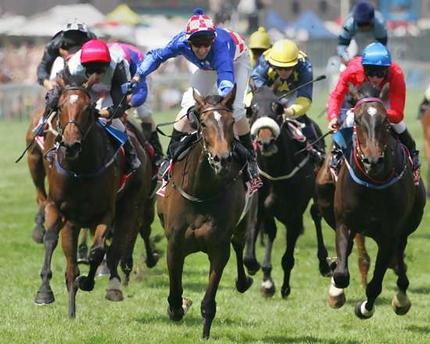
In 2005 Makybe Diva became the first horse in
Australasian
racing history to claim three Melbourne Cups
and a Cox Plate.
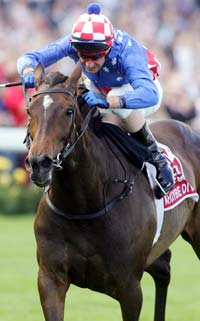
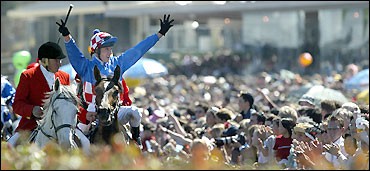
Makybe Diva and Glen Boss with
a Croatian
cap
Photo by Sebastian CostanzoThe Boss with Croatian Coat of Arms
and Makybe Diva
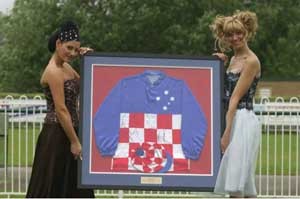
Photo by Wayne TaylorCelebrating
the victory The
winning jersey winning the hearts... ...and
media Mr. Tony Santic is in the
middle, Glen Boss
on the right (Makybe
Diva missing),
with Croatian
Coat of Arms on his jerseyGoooooooogling
with Makybe Diva and with a Croatian hat
...Horses in Croatian Art
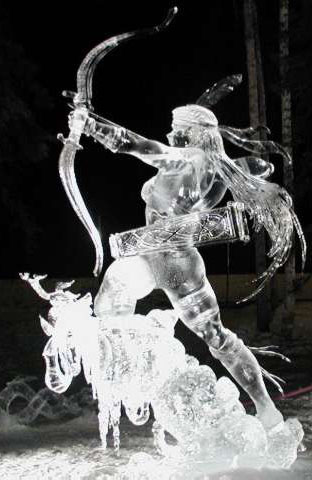
Tajana Raukar: GRACEFUL
PREDATORS
(world
champion medallist in Ice
carving)
World Championship Alaska 2003
Javelin throw
Antonia Balek, Mikela Ristoski, Branimir Budetić
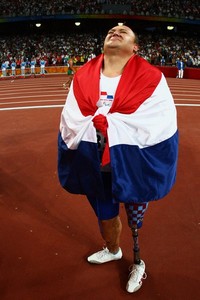
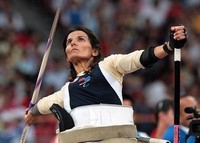
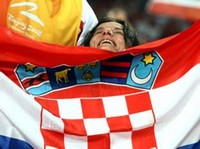
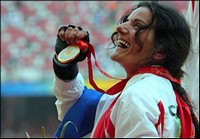
Antonia Balek
won two
gold medals for Croatia at
the 2008 Paraolympic Games in China. The first gold medal has been won
in women's javelin, and the second in women's Shot Put, both with new
world records. The competition was held in the National Stadium known
as Bird's Nest in front of 85,000 spectators. Antonia survived a deep
coma which lasted for 3 years. Photos by Getty Images.
Mikela Ristoski is Paraolympic
champion in triple long jump in Rio 2016, as well as the 2015 world champion in para-triple long
jump..
Branimir
Budetić celebrates with his
mother after finishing second during the final of the men's javelin
F11-12 classification event at the 2008 Beijing Paralympic Games in
Beijing on September 10, 2008. Photos by Getty Images.
Barbara Matić won gold medal in judo
(under 70 kg) at the
Olympic Games in Paris in 2024.
Source of the photo: International Judo Federation (IJF).
Source of the photo: IJF. Meet the champion: Barbara
Matić
Brigita
Matić won gold medal
at the European Championship in Judo in 2012.
Several outstanding
results in karate had Junior
Levevre, a Belgian born Flemish,
who fought under the Croatian flag. He won three european gold medals
and one world's gold (world
champion in München,
Germany in 2000, in the category to 70 kg).
Sveto Deković, Budva Croatian Society
Sveto
Deković
is distinguished Croatian sportsman (karate, judo, jiu jitsu) of
international reputation (European Kyokushin karate champion 2001),
living in Tivat in Boka kotorska, Montenegro.
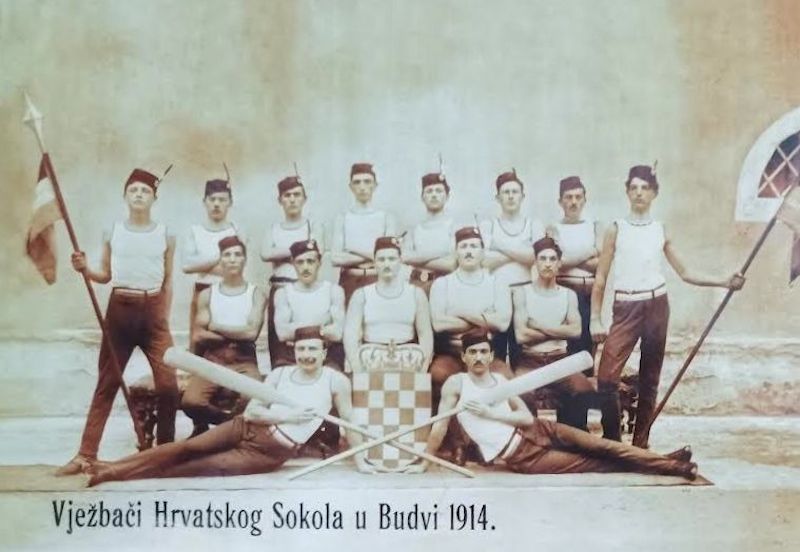
"Croatian Falcon" sports club in Budva (Boka kotorska), 1914
Ana Lenard
Ana Lenard
was European
karate champion for 2014 in
Tampere in Finland.
Marathon
Franjo MihalićFranjo MihalićFranjo
Mihalić (1921) started his
active sporting
career in the period of the Independent State of Croatia
(1941-1945), and after 1945 had to move to Belgrade, jointly with many
other best Croatian sportsmen. He won a silver
medal in Marathon at the Olympic Games in Melbourne (1956);
he was the winner
of the International races in
Sao Paulo (1952,
1954), as well as Marathon
races in Tokyo, Moscow,
Boston, Athens, Cross de
Nations in Paris (1950-1961).
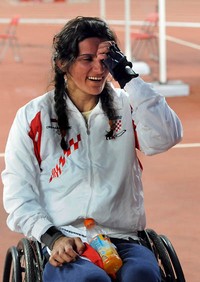
Nikolina Šustić Stanković
Sandra Paović was the 2015 world para-tennis champion of
the world and Paraolympic gold
medallist in Rio 2016. (An amazing achievement, in view of the
dominance of Asian players in ping-pong.)
Anđela Mužinić Vincetić
Anđela Mužinić Vincetić, Europan para-ping-pong champion in Sheffield
2023 (above),
and Olympic para-ping-pong champion in Paris 2024 (below). Photos by
Croatian Paralympic Committee.
Anđela Mužinić Vincetić was the 2024 Olympic para-tennis champion in
Paris. In 2023, she became the European
para-tennis champion in Sheffield, England. (As in the case of
Sandra Paović, this an amazing achievement, in view of the dominance of
Asian players in ping-pong.) Hats off to Mirela Šikoronja, a trainer of
both players.
The
famed scientist (biologist) and
table tennis player, Professor Žarko
Dolinar (1920-2003), who
captured
eight
gold
medals at world championship competitions. Dr. Dolinar still holds an unusual
world record. He is the only
athlete in the world who was a world champion
as
well as a doctor of science.
He was former World
Doubles Champion and had a
prestigious
position of ITTF
(International
Table Tennis
Federation) Sports Science Committee head.
It is interesting that he taught John Lennon to play table tennis
(information by Nenad
Bach). In China he was invited
to have dinner with president Mao Tse Tung, together with R. Nixon,
president
of the USA (information by Nenad Bach).
Except of being
university professor in Zagreb and in Basel,
he also had the title of one of Croatian Righteous
among
the nations.
See also Sandra Paović, para-tennis champion (on this web page).
Dragutin Šurbek
Among
the most
outstanding Croatian sportsmen was Dragutin
Šurbek
(table tennis), who had won hundreds of tournaments, from Tokyo and
Beijing to Zagreb (37
medals from european and world championships!).
In China he is known under the nickname Surbeka,
treated as table tennis God there, and in Croatia as Surba.
Antun Stipančić, often called "the golden left
hand of Croatian sport", was one of the greatest Croatian table tennis
players. In 1965, at the age of 16, he defeated the then European
champion Kjell Johanson by 24:22 in the fifth set, winning Johanson's
two match balls. In men doubles he was gold
medalist during the European Championships organized in Lyon
1968 with Vecko and in Moscow 1970 with Dragutin Šurbek. In 1975 he won the silver medal
at the World Championship in Kolkota in singles and in the doubles -
the gold medal with Dragutin Šurbek
at the World Championship in Pyongyang 1979.
Zoran Primorac
Zoran
Primorac won several important
international table tennis tournaments: in France in 1997, in Qatar in
1998 and other. The tournaments gathered the best table tennis players
of the world.
U
borbi za međunarodno
priznanje Hrvatskog stolnoteniskog saveza. Zoran Primorac, jedan od
najboljih europskih igrača stekao je pravo nastupa na turniru Europa
Top 12 za 1991. godinu, ali kako HSTS još nije bio priznat
kao
samostalni član ITTF-a to je Primorac trebao nastupiti pod
jugoslavenskom zastavom, što je odbio. Nakon pregovora
između
predstavnika HSTS Hudetza i vodstva ETTU postignut je kompromis. U znak
solidarnosti svi najbolji
europski igrači nastupili su u dresovima bez nacionalnih oznaka,
tako da je Primorac mogao nastupiti s dresom bez jugoslavenskog grba i
zastave. Izvor.
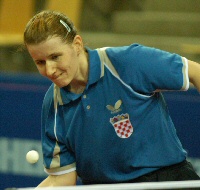
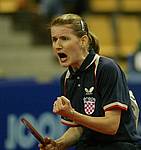
Tamara Boroš
And Tamara Boroš
was the best ping-pong player in the world among women of non-Chinese
origin for 1998 and 1999 (ranked 13th, the first 12 places being
occupied by Chinese players, as well as many places after Tamara).
She is famous for her attractive offensive style.
She was the winner of the
2002 TOP 12 European ping-pong competition in Rotterdam. After this
success she was placed second (!) on the world rank. She won the third
place at the World Championship in Paris in 2003, which is the greatest success of Croatian (and
European!) table tennis in history for
women.
She also won the 2006
Europe TOP 12 competition in Copenhagen.
Tamara is the only one in
Europe capable to cope with ping-pong players from Asia (China, Japan,
etc.). In 2006 she has been invited to China to play table tennis in
their professional league, which is the strongest one in the world. In
1991, as a young girl Tamara had to escape with her parents from what
is now Serbia and Montenegro, when Greater-Serbian aggression on
Croatia started. Her both parents are Hungarians. Together with Janica Kostelić,
Tamara Boroš is one of the greatest Croatian sportswomen in history.
PingPongParkinson (PPP)
Nenad Bach - the founder of PingPongParkinson movement
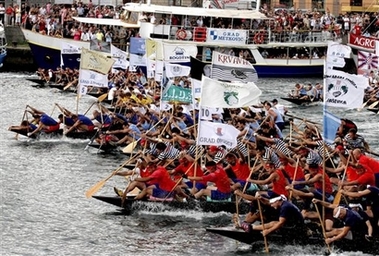
The
earliest known description of a sporting event in Croatia is from the
16th century. It reffered to the 1593
regatta of seventy four
(yes, 74)
wooden fishing boats
called falkusa,
from the harbour of the town of Komiža on the island of Vis to the
islet of Palagruža.
It was the
oldest known boat race in
Europe. Falkusa is
autochthonous Croatian boat of 9m of length, with the mast
of
equal size, in use from 11th or 12th century until the middle of the
20th century.
A
crew
was composed of
five
rowers,
and
the
marathon
covered
42
miles,
for which about five to fifteen hours of continuous and exhausting
rowing was
necessary, depending on weather conditions.
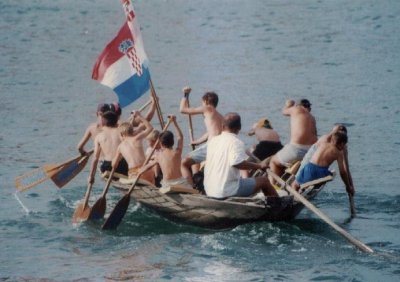
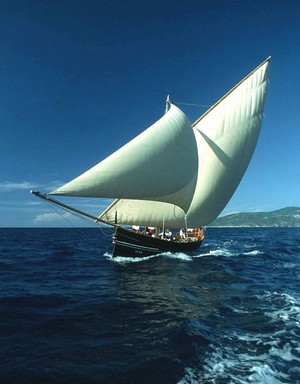
Falkuša autochthonous Croatian boat from the town
of Komiža, island of Vis.
The very start of the
marathon of the armada was announced by a cannon from the Renaissance
tower in the Komiža harbour early in the morning of 20th May. One can
imagine the foam raised by 74 boats and 370 rows in the harbour! The
description of this interesting event is kept in the Liber Comissiae in
the parish of the town of Vis on the island of Vis. In 1998 falkuša was
included into the UNESCO World Heritage List.
See Prvi
zapis
o Palagurškoj regati (in
Croatian), Gajeta
Falkusa, Vis
(in
Polish), The
Falkusa.
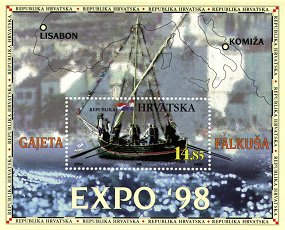
A Croatian falkuša sailed from
Komiža to
Lisabon to be exhibited at EXPO'98, where Croatia was the greatest
surprise. Postage stamp designed by Danijel Popović, Zagreb. Lit. Joško Božanić: Jadranski halieutikon / Gajeta falkuša –
naslijeđe za budućnost, AGM, Zagreb 2017. (English edition in
prepration)
The next earliest known
description of a sporting event in Croatia is from the 18th century
(1764). It referred to the regatta of two fishing boats representing
the cities of Split and Makarska, from an islet near Milna on the
island of Brač to the Split harbour. It was the Makarska boat that
triumphed!
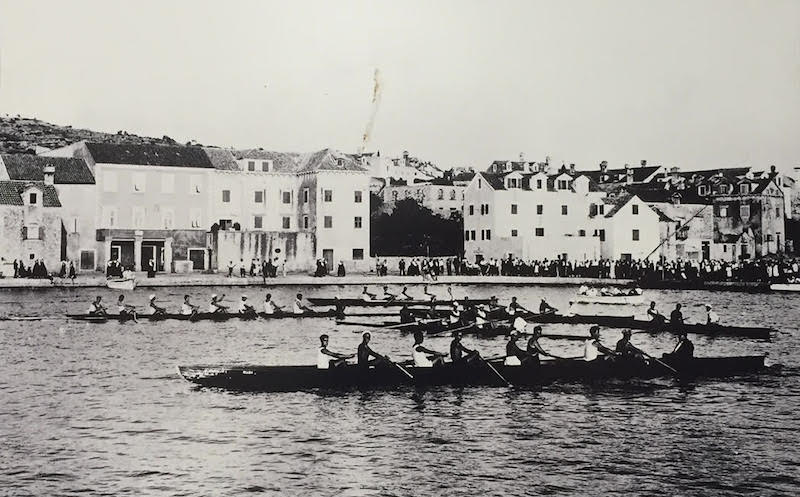
Rowing competition on the island of Zlarin
Rowing competition in the town of Zlarin on the island of Zlarin arround
1900, near the city of Šibenik on Croatian coast.
Zlarin is also known for coral hunting and production of fantastic
coral jewelry.
The nearby island of Krapanj is famous for coral
and sponge hunting.
Rowing club Neptun
The Rowing
Club Neptun (Veslački klub
Neptun) in Dubrovnik
was founded in 1923.
In the school year 1890/1891 the Dubrovnik Grammar School introduced
rowing as
an optional subject within the gymnastics programme and a ten-oar boat
was used
for pupils. Since 2000 the International
Semper Primus Regatta of Student
Eights'(the name is derived
from a Latin proverb: Semper primus, simper melior - Always
the first, always the best). Source Welcome to
Dubrovnik,
2009, no 18, p 27.
Matija Ljubek
Matija
Ljubek has won a fair number of olympic
medals in kayak.
He is considered to be one of the greatest kayakers in the history of
this sport.
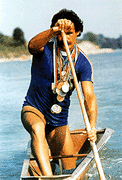
Matija Ljubek
Matija
Ljubek (1953-2000),
gold medal
in single kneeling canoe, 1000 m, at
the Olympic Games in Montreal 1976, gold medal
in kayak, 1000 m, at the
World Championship in Belgrade 1978, gold medal
in single kneeling
canoe at the World Championship in Nothingham 1981, gold medal
in
double kneeling canoe the Olympic Games in Los Angeles 1984, silver on
500 m, and gold medal
on 10,000 m at the World Championship in Belgium (in Mechelen)
1985. Since 2001 the Award of the Croatian Olympic Committee for
lifelong achievement is named after him.
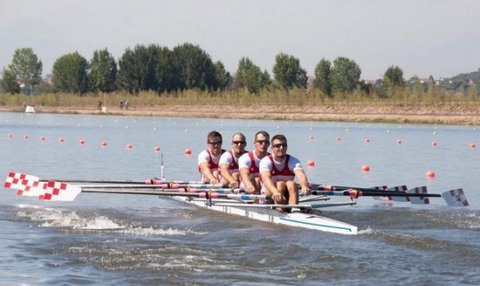
Rowing gold medals
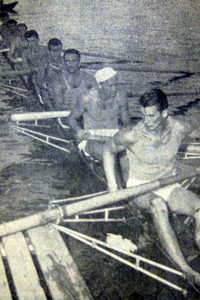
Croatian eight-man boat
(on the above photo) won the olympic gold medal
at the 1952 Olympic Games in Helsinki. It was the first olympic gold
medal in the history of the then state (ex-Yugoslavia). However, the
press never reported about this great succes, since all the rowers
asked for political asylum after the win and moved to Canada. Members
of the team were from the rowing club Gusar
from the city of Split. Many thanks to Dr. Ante Chuvalo, Chicago, for
this information.
Croatian eight-man
boat won the olympic bronze in
Sydney in 2000, being only half a boat after the winning GB. This is
one of greatest results in the history of Croatian sport in general.
The crew, composed of Igor
Francetić, Tihomir
Franković, Tomislav
Smoljanović, Nikša
Skelin, Siniša
Skelin, Krešimir
Čuljak, Igor
Boraska, Branimir
Ujević (+ Silvio
Petruško), trained for only four
months!
Brothers Skelin - Nikša and Siniša
Brothers
Skelin (Siniša and Nikša) won gold medal at
the World cup
in 2002.
Siniša and Nikša Skelin (from www.bracaskelin.com)Tomislav Hohnjec
Tomislav
Hohnjec won the gold medal
of the Wild Water World Championship on the Loishach river in the
German Alps in 2004. This was Croatia's first ever gold medal in a C1
wild water championship. In men's C1 team event in Garmish
Partenkirchen, 2004, Croatia also won the gold
medal,
winning over France (silver), Germany (bronze), Czechia and the USA.
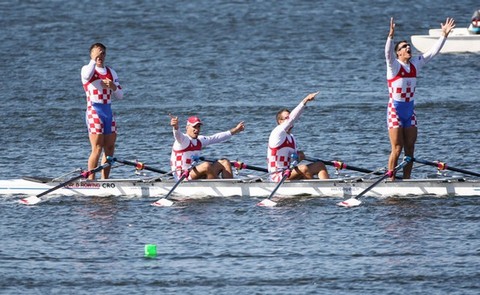
Martin and Valent Sinković borthers, Damir Martin, David ŠainIn
2010 Valent Sinković,
Damir Martin, Martin Sinković i David Šain
became world
champions in Men's Quadruple
Sculls competition in New Zealand.
Croatian single sculls rower Damir
Martin
won bronze Olympic medal (in his words, of platinum glitter) in Tokyo
2021. This was his third Olympic medal: in London 2012 and in Rio de
Janeiro 2016 he won bronze medals.
Martin and Valent Sinković won men's gold medal in Olympic rowing in Paris 2024. Milan Janić, Ivan Šabjan
Milan
Janić won gold medal
in single kneeling canoe at the World
Championship in Belgrade 1978, and silver medal on 1000 m. Ivan Sabjan,
a younger colleague of Matija Ljubek, was the world champion
in C-1 on
10,000 m in Duisburg 1987, Germany.
Nikola Primorac
Nikola Primorac, Croatian captain of City of Ragusa craft sailing from
Liverpool to New York and back in 1870 (also here)
Sailing
Tina Mihelić
Tina Mihelić
won the title of the 2013 world
champion in
sailing in the category of
Radial Laser. This is for the first time in history that a Croatian
sportswoman won such a title. The competition took place in China.
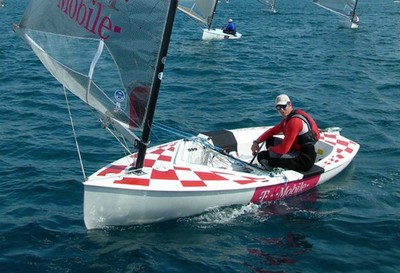
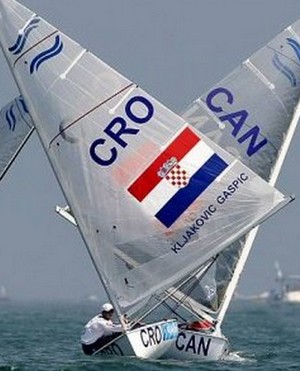
Ivan Kljaković Gašpić
Ivan Kljaković Gašpić
won silver medal at the 2008 Finn European Championship held in La
Marina di Scarlino, Maremma, Tuscany, Italy, in 2008. In 2009 he won gold medal
in the Finn class at the 41st Semaine Olympique Française in
Hyeres.
Ivan
Kljaković Gašpić, Split, Croatia. Photo by Robert Deaves, International
Finn Association. His very nice boat on the photois easily recognizable
by red and silver squares from the Croatian Coat of
Arms.
Šime and Mihovil Fantela brothers, Igor Marenić
Šime Fantela and Igor Marenić
were Men's 470 World
Champions at the
international sailing competition organized in 2009 in Copenhagen in
Denmark. They are both former junior world
champions
in sailing, members of the Sailing club of St. Krševan from the city of
Zadar,
Croatia.
Branka Jankov, Vesna Domazet, Ana Nazor, Mladenka Malenica
Croatia
had excellent results in shooting sport, mainly due to shooting
club Dalmacijacement in the town
of Solin near Split. Among numerous excellent resuts we mention Branka
Jankov who won gold medal
at the 1983 European shooting championship in Dortmund, for which she
was awarded as Olympic flame carrier for the Winter Olympics in
Sarajevo in 1984. In 1986 Vesna
Domazet became world
champion st the World
shooting championship in Suhl, the then Eastern
Germany,
and in 1987 she won gold
medal at the World Cup in
Munich. Ana Nazor
and Marina
Borzić won gold medals
at the European
junior shooting championship
in 1994 in Wroclaw,
Poland. The same year Mladenka
Malenica won gold
medal at
the World
Cup in
Milano.
Many thanks to dr. Josipa-Pina Milišić for her
help in collecting data about the Solin shooting club.
Snježana Pječić, Josip Glasnović
Snježana
Pejčić won bronze medal at
the 2008 Bejing Olympic Games in women's shooting (10m air rifle, 40
shots).
Perica
Vlašić (1932-2004), a famous
Croatian rower, was european
champion in skiff in 1953 in
Copenhagen. He could row for an unbelievable 58 strokes per minute.
This brought him also the world title in skiff at the famous Henley
Royal Regatta in London in 1954,
and he was presented the gold cup by the English Queen in person, the
patron of the regatta. It is funny that, to the amazement of other
sportsmen, Vlašić came to the London town just a day before the
competition, without his trainer, and without any boat. The boat was
lended to him by an English trainer - God bless him.
Skiing
Otto Lang
Otto Lang
(1908-2006) founded the first ski school at Mount
Rainier (a National Park in the
USA) in 1937 and directed Sun Valley's ski school before and after
World War II. Then he launched a successful career as a Hollywood
filmmaker. He was born in 1908 in the small village of Zenica, Bosnia,
to an Austrian father and Croatian mother. One of his best-known pupils
was Gretchen Kunigk of Tacoma, who later won an Olympic gold medal for
the United States in 1948 under her married name, Gretchen Fraser. "He
was an unbelievable human being," said skiing filmmaker and longtime
friend Warren Miller. "He is the last of the old Austrian ski
instructors; it is the absolute end of an era." Miller also called Lang
a "Renaissance man."
Ante Kostelić - Gips
There
is nothing extraordinary that the handball team of Cannes, France, once
won a match scoring altogether 24 goals. But the following is without
precedent: all the goals were scored by one single person! And that
person was Ante Kostelić - Gips
(nicknamed Gips = plaster; guess why!), better known as father of
Weltklasse skiers Janica
and Ivica.
Ante Kostelić-Gips with
friends,
photo from Stanko Kempny
Croatian Mountaineering Society
During ex-Yugoslavia,
although he was one of the best handball players at that time, it had
not been allowed to him to enter the representation, and that is why he
turned to an individual sport of skiing as a trainer. Mr. Kostelić is
not only a great expert in sports, but also a person knowledgeable on
the classical literature.
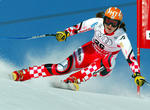
Janica KostelićVELEBIT mountain above the Croatian coast; photo by Mladen Zubrinić
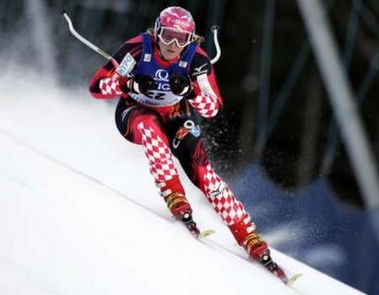
Croatia
is the only country in the world with no mountain above 2,000
meters (though with probably the most beautiful mountain in Europe -
VELEBIT) and with world's top skier - Janica
Kosteli''. She was shining in
women's slalom in 1999 (being only 17 years old). Her second victory of
the season put her in first place in the World Cup overall standings
and strengthened her lead in the specialty standings. In her historical
victory in Serre Chevalier, France, 5. December 1999, the difference
between the first two was 1.78 seconds, the greatest achieved in the
previous 20 years! Her ardent supporter is Goran Ivanišević. In March
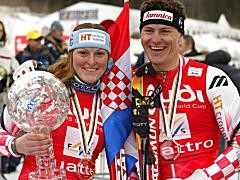
2001 Janica became the World
Cup Champion in alpine
skiing. This is one of greatest successes in the history of Croatian
sport. Upon her arrival to the Zagreb airport she obtained 1256 roses
and custard slices...
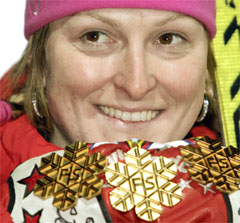
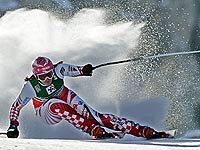
Janica Kostelić, Queen of Winter Olympic Games, with 3 gold medals and 1 silver, Salt Lake City, Canada 2002"
In 2002, at the Winter
Olympic Games held in Salt Lake City in the USA, Janica Kostelić became
the first Alpine skier to win as many as four
Olympic medals
at a single Game: three
gold medals and one silver.
This was a result of many years of painstaking work undertaken already
at her tender age by her father Mr. Ante Kostelić and the whole family.
As stated by Mr. Kostelić, this success would not have been possible
without free Croatia.
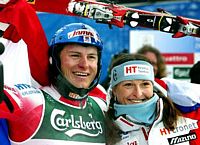
Janica KostelićIvica Kostelić
And Janica's brother, Ivica
Kostelić, stunned everybody with
his win in the 2001 World Cup slalom in Aspen, Colorado, USA, at the
age of 22. He skied out of the 64th position in the first run, then was
fastest in the second run to win in 1 minute, 38.81 seconds. It was the
latest starting position for a slalom winner in World Cup history and
third latest in any event. In December 2008 he secured his ninth career win
at the Alta Badia slalom in Italy. Ivica is also known as the best
blues and rock guitarist among skiers, and at the same time the best
skier among blues and rock guitarists.
Ivica and Janica Kostelić, world champions in slalom in 2003.
1. Ivica Kostelić, Croatia, 1 minute, 38.81
seconds. 2. Giorgio Rocca, Italy, 1:38.93. 3. Mario Matt, Austria,
1:39.00.
In 2003, Ivica and Janica
Kostelić both won the title of world
champions in slalom.
They became the first siblings to win gold medals in the same event at
the world's.
In 2006 Janica won gold
medals in combined event at the
Olympic games in Torino,
Italy, and silver medal in Super-G.
With this achievement (four gold medals
and two silver on two Olympic Games) she became
the most successful skier among women
in the history of Olympic Games
the first alpine
skier, male
or female, to win four medals
at one Olympics.
the first female
alpine skier to win six Olympic medals.
Her brother Ivica won
silver olympic medal in men's Alpine skiing combined event.
The
life of the family of Kostelić is unique in the history of skiing sport
(and may be in the history of sport in general). When Janica and Ivica
were very young, they used to travel with their old Lada (Russian car),
and also to sleep and eat in the car. At the same time other children
stayed in a hotel, sleeping in their warm beds. Kostelić's were
sleeping also in a small mountain tent, sometimes at the temperature
reaching -20 degrees Celsius. They were not able to pay for their
trainings, so they used to wake up at 4 o'clock in the morning, to wash
their faces with snow, and train at dawn (free of charge) with their
worn up gloves, while others were still sleeping or having breakfast.
Janica and Ivica KostelićIvica and Janica at the
Olympic games in
Salt Lake City,
USA, 2002, photo by Getty Images
It
is well known that skiing is the sport of the rich. When Kostelić's
went back home from Austria, Germany, France or Switzerland, several
times it happened to them that they had to sell their skies in order to
be able to buy petrol for their Lada... And let us not forget, at that
time the Greater
Serbian aggression was raging
throughout Croatia and Bosnia-Herzegovina
(1990-1995). Mr. Ante
Kostelić-Gips himself, father of
Ivica and Janica, is an amazing Croatian sportsman and trainer, former
handball player, working with his children on the long run. He
remembers with deep gratitude an Austrian, Mr Willie Arnsteiner,
wire-keeper, who donated them 100 Schillings daily during a critical
period, and who predicted their great skiing future. At the age of 15
Janica had 22
consecutive wins at European
competitions for children during one season. One day after the death of
president Franjo Tuđman, Janica was skiing with mourning black
armband. Young Kostelić's were raised in deep patriotism, and their
sacrifices will always be remembered. Let us also mention a regular
short ritual of Christian crossing immediately before every
competition. It is amusing to see how "objective" European TV media
strive to avoid this indicative and important detail.
Janica Kostelić, Queen of the World Alpine Ski Chapionships, with 3 gold medals, Italy, 2005. Janica with her three
olympic gold medals
Salt Lake City, USA, 2002.
At
the very end of 1999 Janica had a tragic fall: four of her ligaments
on the knee out of five were broken. After a very difficult operation
and reconstruction of her knee, she had a painstaking program of
getting back to normal living. She was able not only to walk again, but
also to win on European, World, and Olympic competitions in skiing.
The
human story of Kostelić's is waiting to be written in
all details,
with a special emphasis on low blows of "independent" media. This story
is much greater than the story about their sport successes. Ivica and
Janica, like many others on this web page, would never have appeared
without the advent of free Croatia.
Janica Kostelić
winning the 2006 Women Alpine Ski World Cup super-G race
in Bad Kleinkircheheim (photo by Ruters/Calle Teornstroem).
Janica
with Croatian
coat of arms (AP Photo/A.
Trovati), Sweden, 2006
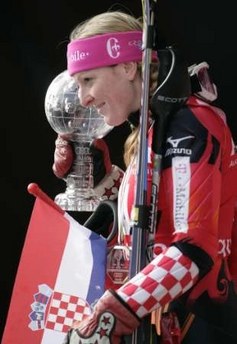
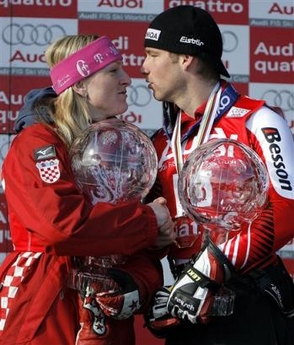
World
Cup champion for the third
time,
set a
new single-season points record
for women after winning the final Alpine skiing race of the season in
the giant slalom.Janica Kostelić and Benjamin Reich (Austria), in Sweden 2006Croatia's
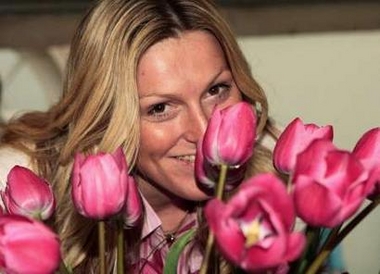
alpine skiing champion Janica Kostelić smells a brand new variety of Dutch-grown tulips named after her
at a ceremony in Zagreb, 2006. A Dutch tulip grower Cor Grooteman from
the town of Lisse, the Netherlands, asked Janica Kostelić for
permission to use her name for the new sort of tulips, thus honouring
the World Cup winner and Olympic champion. REUTERS/Nikola ŠolićJanica
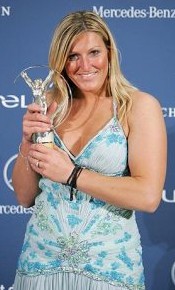
- winner of the
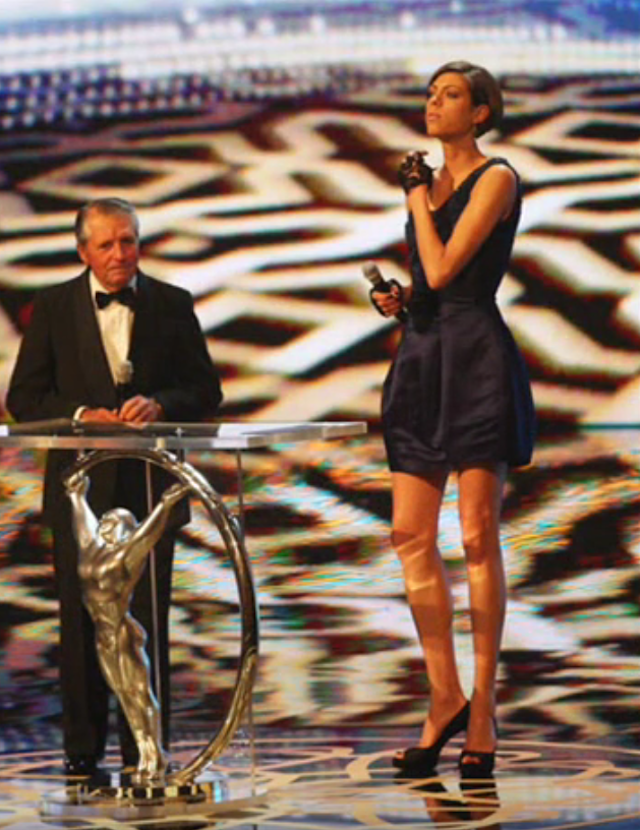
2006 Laureus
World Sports Award, Barcelona
Photo by ReutersIvica
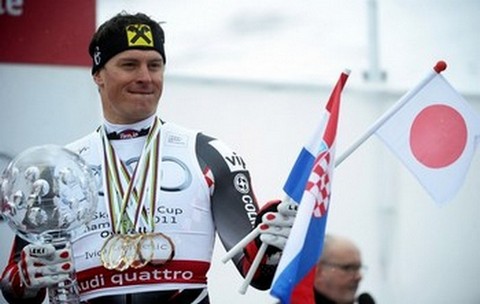
Kostelić won
the
World Cup slalom title, the combined
World Cup
title,
and the
overall World Cup title
in
2011. He poses with a Japanese
flag in
tribute to the victims of the earthquake and ensuing Tsunami. Photo by
Getty Images.
Japanese skier Akira Sasaki
had his greatest sports achievement in 2003 on the skis of Ivica
Kostelić. Namely, Ivica Kostelić lended him, upon Akira's request, his
own pair of skis. On that occasion (World cup men's slalom in Wengen,
Switzerland), Akira was placed the 2nd, and Ivica the 3rd.
Jakov FakJakov Fak, biathlon athlet, wearing the Croatian national flag at the
solemn opening of 2010 Winter Olympic Games in Vancouver, Canada.Jakov Fak, biathlon athlet. These two photos by Getty Images.
Jakov Fak, Croatia's
biathlon skiing athlet, won a bronze medal in the 10 km sprint at the
2010 Winter Olympics Games in Vancouver.
Sprinting
Rudolf Matz
Rudolf Matz
(1901-1988), a famous cello player and music educator, professor at the
University of Zagreb, was a top Croatian sportsman. As a sprinter he
won the first place in the Prague in 1921, beating also German
sprinters. He was a record holder in Croatia on 100 (for 11 years!),
200, 4x100, and 400 m. He stressed that the
work of a music educator is similar to that of a trainer.
Lit. Zrinka Jelčić: Veliki opus
vedrine /
Rudolf Matz, Muzej Grada Zagreba, Zagreb 2017.
Surfing
Sofía Mulánovich
Sofía
Mulánovich Aljovín
(Sofia Mulanovich) is a Peruvian surfer of Croatian descent. She is the
first Peruvian
surfer ever to win an Association of Surfing Professionals World Championship
Tour event. In 2007 she was inducted into the Surfers Hall of Fame, and
in 2009 into the Olympic Museum in Laussane in Switzerland.
Swimming
Swimming club Victoria in Rijeka founded in 1908
The oldest Croatian swimming club Victoria was founded in 1908 in the
city of Rijeka
(more precisely, in Sušak). It served to high school students.
Note the Croatian Coat of Arms appearing in the amblem.Veljko Rogošić
Veljko
Rogošić was named International
Long Distance Swimming Federation World Champion
four times
between 1971 and 1974. He was the first one to
have swam the
distance of 200 km without interruption.
From the town of Grado near Trieste in Italy to Riccone near Ancona he
set the
world record of 225 km in
long distance swimming (during this swim he lost 16 kg).
Veljko Rogošić (photo from www.veljkorogosic.org)
In 1992 this outstanding
sportsman entered the International
Marathon Swimming Hall of Fame,
Florida, USA. He was participant of the Homeland War during
Greater-Serbian aggression on Croatia and one of the founders of
Croatian Marine Corps. Recipient of the Medal of Homeland War from
president Franjo Tudjman. His motto and message to young people is
Rogošić swam La Manche
(45 km) in 2004 at the age of 63! For this he needed 11 hours and 27
minutes. His name was written in the 'Gold book of La Manche' as the
first Croatian and the
oldest man to do so.
In the summer 2005 he
swam almost 1,000 km
along Croatian coast (from Savudrija to Rt Ostro in Konavle)
in less than two months, at the age of 64! Also, this is the ultra-marathon swimming world record
(880 km in 222 hours, in 57 etapes in less than 58 days).
In 2008 Rogošić swam
171 km marathon
from Sicilia to Africa, and
reached Africa's Cape Bon in Tunisia. He started the
first marathon from Europe to
Africa on his 67th birthday!
Đurđica Bjedov
Đurđica
Bjedov won the Olympic gold medal
in 100 m brestroke swimming during the 1968 Summer Olympics in Mexico
City, breaking the then Olympic record. She was the first Croatian
sportswoman to win an Olympic medal. At the same olympiade Đurđica
also won silver medal in 200 m breaststroke.
Miloš Milošević
In
1998, in the finals of the European Championship held in Sheffield,
England, Miloš Milošević
set the new world
record in the 50 meter
butterfly (23:30), thus beating the world record of the Russian swimmer
Denis Pankratov, that many held unbeatable.
Miloš Milošević, world record
on 50m butterfly in 1998
Miloš is a native of
Split, now living and training in Rijeka.
Tomislav Karlo
In 1997, during the FINA World Cup organized in Paris, Tomislav Karlo set a European record in 50 m backstroke. In 2000, he became the winner of the FINA World Cup.
Gordan Kožulj, Mirna Jukić
Gordan Kožulj was European champion
in 2000 in backstroke swimming with 1:58.62 on 200m.
Gordan Kožulj, gold medal in Berlin, 2002Mirna Jukić,
Croatian
swimmer in Austria (born in in the town of Vukovar, destroyed during
the Greater
Serbian aggression on
Croatia),
was elected the
2002 Sportswoman in Austria
for her results in breaststroke swimming.
Duje Draganja
Duje
Draganja won the Olympic silver medal
in men's 50m freestyle final, Athens, 2004.
Duje Draganja breaking the world record
in 2008 in Manchester.
In 2008, Duje Draganja
broke the men's 50 metres freestyle world record
at the finals of the World
Short Course Swimming Championships
in Manchester, UK. This was one of the greatest successes in the
history of Croatian sport.
Sanja
Jovanović from the city of Dubrovnik,
broke the world
record in 50 meters
backstroke on European Short
Course Swimming Championships
in Hungary, 2007. This was one of the greatest achievements in the
history of Croatian sport.
Sanja Jovanović, 2007, world record in 50m backstroke
Sanja Jovanović, world champion
in 50 m backstroke, 2007, AP Image
Sanja Jovanović with gold
medal, breaking
her own world
record, and China's Gao
Chang, silver, during the medal ceremony for the final of the Women's
50m backstroke at the World Short Course Swimming Championships at the
MEN Arena in Manchester, England, 2008. (AP Photo/Paul Thomas)
Sanja Jovanović broke
her own world record on 50m
backstroke swimming at the 2008 World Swimming Championships
Manchester, UK. Her new world record time is 26.37.
She
again won her new gold
medal at the European
Swimming Championship held in Istanbul, capital of Turkey, 2009. And
not only this, she broke the world record
on 50 m backstroke, and her new world record
is 25.70. This was her fourth world record in swimming at international
competitions.
Dina Levačić, marathon swimmer, was he first
Croatian woman to have swum across La Manche (or in English: English
Channel), 2019.
Toni Pavičić-Donkić
Toni Pavičić-Donkić
was the first Croat to swim across Gibraltar, 15.5 km, in 2007. It took
him 3.09 h, which was the fourth time in history.
Toni
Pavičić-Donkić
swimming across La Manche (The English Channel), 36 km, in 2006.
He was the second Croat to swim across La Manche, the first one was Veljko Rogošić.
Toni Pavičić-Donkić; photo from
www.hsdp.hr; many thanks to
Mirko Crnčević for help.
Ana
Srsen is a top Croatian
paraolympic swimmer, very successfuly competing at interanational
competitions for disabled. In 1998 she became a world
record holder
on 100 m breast-stroke. In 2002 she set two
world records
at Interantional Competition in Zagreb: on 200 m and on 800 m
freestyle. Interview with Ana Sršen (in Croatian).
Mihovil
Španja,
a top paraolympic
swimmer, set a world
record on 50 m breast-stroke
for disabled in Berlin in 2008. At the 2008 Paraolympic World Cup in
Manchester he won silver medal on 100 m backstroke.
During the 2010 World
Championship in the Netherlands 2010
Mihovil Španja won paralympic gold
medal on 400 m
freestyle in large pools with a new world record
4:47.39, and
another gold
medal on on
100 m breastroke, again with a new world
record 1:25.11. At the same
competition he won silver medal on
100 m backstroke,and
another silver medal on 200 m mixed style with a new European record
2:37.32.
Darko Kralj
won gold
medal at the 2008 Beijing
Paraolympic Games in China. Competing in Men's Shot Put he broke a new
world record at the National Stadium known as Bird's Nest. He said: "My
biggest wish was to listen to the Croatian anthem in Beijing." Mr.
Kralj lost his left leg during the Serbian aggression on Croatia.
Photos by Xinhua.
Antonia Balek won two gold medals during the Olympic Games in Bejing, China 2008:
Tennis
Dragutin Mitić and Franjo Punčec
The first known traces of
tennis playing in Croatia date from 1878 (in Zagreb and Samobor). The
first Davis Cup match in Croatia was played in Zagreb in 1927. In the
finals of the 1939 Davis Cup match for the European zone, held in
Zagreb, the Croatian team defeated the representation of Germany. The
players who brought this victory were Franjo Punčeć and Dragutin Mitić.
This was probably the gratest international success of Croatian sport
in the first half of the 20th century. Besides the USA and Australia,
by the end of 1930s Croatia had the strongest Davis Cup team in the
world. See Povijest tenisa u
Hrvatskoj, [PDF].
Dragutin
Mitić (1917) was a
distinguished Croatian tennis player. In 1938 Simone Mathieu (France)
and Mitić became the Roland
Garros mixed double champions.
In 1939, playing with Franjo Puncec, he defeated the German Davis Cup
team at the European zone finals in Zagreb. From 1954 until 1965 he
worked as a tennis professional in Bogota, capital of Columbia. It is
interesting that his photo appears on a Colombia stamp, see below. In
1965 he immigrated to the USA.
Dragutin Mitić, Croatian tennis
player on a
stamp in Columbia.
Photo of the stamp by Vladimir Novak.
Željko Franulović
Željko
Franulović is one of the
greatest players
in the history of the Croatian tennis. He was one of the most important
personalities in the organizational structure of the ATP
(Association of Tennis Professionals). He was the
proprietor of the ATP tournament in Geneva, director of the
prestigious Masters' tournament in Frankfurt. He prepared
an ATP tournament held in Zagreb in 1996, where Goran
Ivanišević triumphed (the same day Iva Majoli triumphed in
Tokyo; indeed, a great day for the Croatian tennis).
He was among the
top ten in the world in the 1990's.
Iva Majoli
Iva
Majoli
(winner
of Roland Garros at the age
of 18, Paris, 1997, at that time 4th
on the world list)
Mirjana Lučić
Mirjana Lučić
has won the 1998 Australian Tournament in doubles
at the age of 15,
together with the world champion Martina Hingis.
Nikola PilićNikola
Pilić was a tennis
trainer winning with two different national teams: first with the
German Davis Cup representation, and then with the Croatian representation.
Silvija Talaja
In the finals of the 2000 Gold Coast Open Silvija
Talaja beat Concita Martinez,
1994 Wimbledon Winner.
Ivan Ljubičić, Mario Ančić, Ivan Karlović, Nikola Pilić
In
2005 Croatia managed to win in the
Davis Cup quarter-final match against
very strong USA team
on "their territory". Ivan
Ljubičić (Bosnian Croat
born
in Banja
Luka) defeated Andre Agassi and
Andy Roddick, and with his colleague Mario
Ančić brought
victory against brothers Bryan in the doubles. Until the match with
Croatia in
2005
the USA Davis Cup team has never lost a round at home in 105 years
of
play!
Furthermore, Croatia is only 12th country in history to win the Davis
Cup.
Andy Roddick congratulating Ivan Ljubičić, Davis Cup, USA 2005 (AP Photo/Kevork Djansezian)
Croatian
team won the
2005 Davis Cup
in the final match with Slovakia in Bratislava. This is one of the
greatest achievements in the history of Croatian sport. Members of the
team were
Ivan Ljubičić,
Mario Ančić,
Ivan Karlović, and
Goran Ivanišević.
Winners of 2005 Davis Cup: Ivo Karlović, Goran Ivanišević, Nikola Pilić, Mario Ančić, Ivan Ljubičić (photo by Associated Press)
Nikola
Pilić, leader of the team, thus became the first captain in the history
of Davis Cup to win the trophy for different nations (he led Germany to
Davis Cup titles in 1988, 1989 and 1993).
Marin Čilić
Marin
Čilić won the 2005 Roland
Garros gold medal in Paris in the junior category (at the age of 16, as
one of the youngest competitors). He lost only one set in the whole
tournament. Marin was born in the famous Međugorje
in Bosnia
and Herzegovina. In 2017 he reached the finals of the Wimbledon
tournament, loosing to R. Federer.
Marin Čilić, winner of Roland Garros, 2005 (AP Photo, Francois Mori)
Filip
Grgić won gold medal at the
2007 Bejing WTF World
Taekwondo Championships in
male bantamweight (under 62 kg) category, China. Photo from www.wtf.org.
Martina Zubčić, Sandra Šarić
MartinaZubčić
(feather category, under 57 kg, on the left) and Sandra
Šarić (under 67 kg) won
bronze medals in taekwondo at the 2008 Bejing Olympic Games.
Matea Jelić, Brigita Matić
Matea Jelić of Croatia won taekwondo gold medal at the 2021 Olymic
Games in Tokyo. This was the first gold medal in this sport for Croatia.
Waterpolo
Croatian waterpolo
Croatian waterpolo team, led by
their coach Ivica Tucak, won
the title of World
champions for the second time, in Budapest, Hungary, 2017.
Croatian team: Bijač, Marcelić, Macan, Fatović, Lončar, Joković,
Buljubašić, Vukičević, Bušlje, Sukno, Krapić, Šetka, Garcia. We mention
that Xavier Garcia is of Catalonian origin.
Croatia won the
prestigeous FINA
World Championships waterpolo
competition held in Melbourne, 2007, with a perfect score of six
consecutive wins. In 2017, they won the same title of FINA
World Waterpolo Champions for the second time.
Samir Barač, a member of
Croatian waterpolo
team winning the title of World champions
in Melbourne, 2007 (source: CROWN)
Miho Bošković
Miho
Bošković, from the City of Dubrovnik,
was proclaimed the
best European waterpolo player
for 2007 by LEN (Ligue Européenne de Natation), ie by the
European Swimming League. By the way, Miho is professor of piano, which
he studied at the Music Academy in Split. Photo from www.crowaterpolo.com.
Croatia became European waterpolo champion
for 2010. The championship has been organized on Croatia's capital
Zagreb, and the event was described as the best so far.
Mladost-Zagreb
is the
most successful water polo club in the world,
with the
greatest number of world's
and European
trophies in its hands (seven
times: 1967, 1968, 1969, 1971, 1989, 1990, 1996).
In 2003 Mladost was awarded the newly founded yearly prize of
the AWPC
(Association
of Water Polo Clubs) in Budapest, Hungary, for their contribution to
the world wide popularity of water
polo. Players of the Mladost (= Youth) team are nicknamed žabci
(froggies;
zaba = frog).
Žabci (Froggies), players of Mladost-Zagreb
water polo club
Jug - Dubrovnik waterpolo club, Elvis Fatović
Here is an excerpt from a
lovely description of the 2001 triumph of the water polo club Jug from
the famous Dubrovnik,
winning the European
Champions League, taken from www.waterpolo.com:
Elvis
Leads JUG To "FINAL FOUR" Title Dubrovnik,
Croatia, May 19- Water polo is a national obsession in this beautiful
Dalmatian coast port city, but it had been twenty years since Jug, the
local club, had won the European Champions league. For the six thousand
lucky souls who got tickets to the Gruz swimming stadium for this
year's "Final Four," the championship game of professional water polo's
premier event was a night to remember. The atmosphere at European water
polo matches is unlike any event staged in the United States. Drums,
air horns, flares and constant yelling - cheering, singing or whistling
- depending upon the moment. It's impossible to hear the announcer and
a wonder that the players can hear the signals from the referees. This
year's event even had an appearance by Elvis. Elvis Fatovic that is.
And it's hard to imagine Elvis Presley getting more cheers than his
Croatian namesake when he scored the game's first goal at the
two-minute mark...
Elvis Fatovic with the trophy
of the 2001 European
Champions
League in water polo
Water polo club Jug from
Dubrovnik, founded in 1923, was three times the winner
of the Eureopan Champions
League: 1980, 2001, 2006, and winner
of European Supercup for
2006.
Croatian waterpolo team, led by
their coach Ratko Rudic,
won the title of World
champions in Melbourne, 2007
(source: CROWN)
Weight-lifting
Dean Lukin
Dean
Lukin is a famous weigthlifter
in Australia. He has Croatian roots: his father Dinko Lukin, a famous
tuna farmer in Australia, is from Croatia. In 1984, with the assistance
of an Eastern European and USSR boycott of the Los Angeles Games, Dean
Lukin won Australia's
first weightlifting gold medal
at an Olympic Games.
His win was in the Super
Heavyweight category (approximatly 140 kg), and in fact he was the
first ever in the history of the sport to do so (snatch 172.5 kg, clean
& jerk 240 kg, total 412.5 kg). Dean, a full-time tuna
fisherman and part-time weightlifter, had the honour to carry the
Australian flag during the closing ceremony of the 1984 Olympic Games.
... One great achievement is to do a
"P.B.": personal best. They want to achieve the Olympic motto
"Citius--altius--fortius": "Faster, higher, stronger". Whenever an
athlete achieves beyond his or her best ever achievement, then you have
a success, whether a medal is won or not.
One personal best
which stands out in my memory, resulted in a gold medal for Dean
Lukin in the Los Angles
Games 1984. Dean Lukin,
from Port Lincoln, South Australia, was an amateur in Olympic weight
lifting. He was the son of a fisherman who worked for his dad. He built
massive legs and arms hauling in huge blue fin tuna from the southern
ocean. He was 24, already a millionaire, owning a white Mercedes and
two light planes. He won gold in the super-heavyweight division in the
Commonwealth Games and the national titles. He trained only in the 16
weeks prior to the Olympics because work came first. The super
heavyweight lifters from Russia, the Eastern block countries and
America trained full-time, held all the records, and had won every
previous Olympic gold medal. At Los Angles Dean
Lukin was to lift his
personal best.
After the first
round he trailed in third place behind the American Mario Martinez who
was the favourite and Manfred Nerlinger from West Germany.
Dean Lukin, after the
snatch was 15 kilos behind Mario allowing for the personal weight
difference. In the final clean and jerk Mario lifted 220 kilograms, his
personal best. But Lukin
with a great effort lifted 222 kilograms.
The West German
tried for his personal best but fell flat on his back. Then Lukin
lifted 227.5 kilos, his personal best. Lukin
was now guaranteed at least a silver medal. Mario then lifted another
personal best of 225 kilos. 10,000 American spectators roared, certain
their man had won the gold medal. Mario Martinez came back on stage for
three encores. Lukin
was, on the combined weights 12.5 kilos behind, and he had just lifted
his personal best for the second time.
The speakers
announced "Dean Lukin
will pass other lifts and go for gold. He has ordered the bar to be
loaded to 240 kilos." The crowd was stunned. As he walked on stage, Lukin
was attempting 12.5 kilos more than he had ever lifted before. With the
cleanest of clean and jerks he heaved the bar above his head, holding
aloft the equivalent of two large refrigerators! The judges signalled a
clean lift. He had won. The crowd went delirious. I jumped high into
the air! That night the Russians took him out to dinner, treating him
like a hero because he had defeated the Americans. He had done his
best. ...
The point of
personal best, is not an individual achievement. Dean
Lukin had his coach by his
side focusing his energies. His mother was in the dressing room urging
him on in a way that made him determined. A personal best is a quality
that is achieved by human effort plus the help and support of others.
...
Dr John F.
MacArthur, Jr. "The Gospel According To Jesus" Zondervan, 1988. [source]
Nikolay Pechalov
European
champion Nikolay
Pechalov (of Bulgarian origin)
won Croatia's Olympic
gold medal in weightlifting
in men's 62 kilogram class in Sydney in 2000. He set an Olympic Games record
of 150 kg in the snatch and lifted 175 kg in the clean and jerk for a
combined total of 325 kg, an Olympic record. His principal sponsor was
Goran Ivanisevic.
Wrestling
Marijan Matijević Marijan
Matijevic in 1899, at the age of 21.
Many thanks to Andreja Malovoz, Zupanja, for her kind help.
Outstanding
Croatian wrestler ("Junak iz Like"
- Hero from Lika) was Marijan
Matijevic (1878-1951). Matijevic
traveled throughout the world to exhibit
his extraordinary physical power (bending metal rods, stone breaking),
including
China and Japan. He is known to have
surpassed Primo Carnera from
Italy. Buried in the town of Zupanja near Danube. He is known for his
numerous
humanitarian public performances. Matijevic was enormously popular,
which can
be seen from thousands of articles published throughout the world in
English,
German,
French,
Italian,
Spanish, Arabian, Turkish, Chinese, Japanese and other languages.
Once in the USA, when he was once introduced as an "Austrian athlete",
he hastened
to correct the announcer: "Dear gentlemen, I am not Austrian, I am
Croatian born
in proud Lika...".
Among plenty of his
decorations and medals let us mention that the last Turkish sultan
Abdul Hamid V decorated him in person in Ankara with the medal of the
Great Turkish Star in 1904 (on the above photo, source lickisamson.blog.hr),
as the winner
of the World championship in wrestling
in Constantinople.
Marijan Matijevic's
famous walking stick made of steel, weighing 12.5 kg, kept in the City
Museum of Vinkovci.
An announcement:
Marijan Matijevic: Strongest man in the world, Junak iz Like (hero from
Lika),
holds with his mouth 950 lbs, holds on himself 2500 lbs,... Source lickisamson.blog.hr.
Marijan Matijević met Nikola
Tesla in New
York in 1921, and on that occasion he
financially supported Tesla's experiments. Both
Tesla
and Matijević originate
from the same part of Croatia, called Lika,
north of the mountain of Velebit.
Reference
Stjepan Tomić: S Herkulom zlatna srca / Marijan Matijević
- "Junak iz Like", Hrvatski crveni križ, Vinkovci 2003. ISBN
953-99195-0-9 (many thanks to Mrs. Katarina Filipović, Županja, for
information about this book)
for headlock move (in
French, English, Italian, Turkish, Croatian, Polish, and other
languages). This term, used also for necktie,
has been derived from the Croatian name.
Anton Baričević
Anton Baričević
(1925-2003, with the second name also written as Barichievich), was a
professional wrestler and a man of incredible power, a frequent guest
of the USA media (appearing with Pierre Trudeau, Liza Minnelli, Lee
Majors, Sophia Loren, Johnny Carson, Frank Sinatr, Mohammad Ali,
Michael Jackson, and even with Mother Theresa), born in Veli Lošinj on
the island of Lošinj in Croatia.
Stevan Horvat
Stevan
Horvat
was distinguished
Croatian wrestler, twice the
world
champion in the
category up to 55 kg: in 1963 in Helsingborg, Sweden, and in 1966 in
Toledo, USA. Subsequently he was instructor and coach
of national
wrestling teams of Japan, USA, Guatemala, Honduras, Slavador and the
Netherlands. More information can be seen in the Leksikon
podunavskih Hrvata - Bunjevaca i Šokaca,
part 9 (H),
pp. 62 and 63. In 2012 a bust was unveiled in his honour at the
University of Novi Sad. The meaning of his second name, Horvat,
is just - Croat.
According to Olympedia, Horvat was most proud of the Pierre Coubertin Fair Play prize he received in 1966, one of the first athletes to be awarded this, for refusing the gold medal at the World Championships after two of his strongest opponents had been disqualified.
Following his sporting career, Horvat graduated from the Zagreb University of Physical Education in 1972, where he also obtained the title of Magisterium. In 1975, he began teaching at the University of Physical Education in Novi Sad, where he taught martial arts until his retirement.
Edward "Moose" Cholak
Edward "Moose" Cholak
became a wrestling star at
Chicago Vocational High School and went on starring for 40 years as he
took part in 8,000 matches, in 1963 becoming world champion.
Unclassified
ARCTIC EXPEDITION in 1872-1874
One of truly fascinating
exploits in which Croatian
mariners participated is related
to ARCTIC
EXPEDITION in 1872-1874,
organized by the then Austrian-Hungarian Empire.
The Croats at that time had the status of Kingdom
within the Empire.
Fiorello La Guardia
Young Fiorello
La Guardia (1882-1947) played soccer in the city of Rijeka (Fiume)
in 1905,
then at the age of 23,
here in the middle of the second line. The soccer club was a part of
the Club Atletico Fiumano,
and La Guardia served as American consul in Rijeka in 1904-1906. He was
the greatest mayor in the history of New York. LaGuardia Airport in New
York is named after him. Fiorello La Guardia learned Croatian language
in these years.
When Nikola Tesla,
distinguished Croatian inventor, died in 1943, he read a nice
euology via radio
as a Mayor of the city of New York. Source of the photo: www.formula1-dictionary.net/rijeka_povijest_1900-1925.html
Ivan (Juan) Bjelovucic
Ivan Bjelovucic the first in history to fly over
the Alps in 1913
Ana and Lucija Zaninović sisters, Matea Jelić, Ivana Babić, Ana Lenard
Ana Zaninović was the World taekwondo
champion in 2011.
Two twin sinsters Ana and Lucija Zaninović
were European
taekwondo champions for
2014 in
Baku, Azerbaijan. Young Matea Jelić and Ivana Babić
were the World
junior taekwondo champions in
Taiwan in
2014.
The leader of very
important team responsible for computer support of Olympic Games is Boris
Sakač, Zagreb, Croatia, in the
course of many years, starting from Moscow Olympic Games held in 1980,
till Athens in 2004.
Charles Billich
Charles Billich
is outstanding Croatian painter born in Lovran in Istria, and since
1956 working in Australia. He is Honorary Citizen of Atlanta,
Centennial Olympic City, USA, since 1996. Billich was the official
artist of the Australian Formula 1 Grand Prix Melbourne in 1996. In
1997 he was designated the official artist of the Australian and French
Olympic teams for Olympic Games in Sydney in 2000.
He was elected the official painter of Australian and the USA national
teams at Olympic Games in Greece, 2004. In 2004 he was elected the Official Artist of the 2008
Beijing Olympiad. Billich's
painting entitled Beijing
Cityspace was the official image
used by the Beijing Olympic Organizing Committee in its bid to host the
2008 Olympic Games. He also conceived a series of sensational images
based on the "Bing Ma Yong" terracota warriors, imbuing them with a new
life and everlasting future, see the Chinese TV web page
and
for more details.
Charles Billich: Archer (Bing Ma Yong, China); from www.asama.org, see the above slide show
Charles Billich's Bing Mah Yong cycle of paintings for the needs of the
2008 Beijing Olympiade was so well received that his paintings are
represented on a collection of 16 postage stamps
currently in circulation in China. Here are some of his collections
related only to sports:
Australian Olympic
Committee Headquarters, Sydney
International Olympic
Museum, Lausanne, Switzerland
Selengor Turf Club
Equestrian and Sports Center, Kuala Lumpur, Malaysia
United States Sports
Academy
QinShiHuang BingMa
Yong Museum, X'ian, China
Ante Glibota
In 2004, the China
International
Culture Exchange Center (CICEC) in Beijing appointed Mr. Ante Glibota,
Croatian historian of art and
architecture, for a fiveyear term as Foreign Counselor for
International Cultural Exchanges. Since 2010 he serves as
Vice-President and Curator-in-Chief of the Museum of Art and Urbanity
in Shanghai, China. He was appointed curator and editor of
“Art
and Sport”, an exhibition organized by Adidas and the
International Olympic Committee for the Olympic Games 2008 in Beijing, China.
Jovica Kozlica
Jovica Kozlica
from the city of Split was paper wings world
champion
in Salzburg 2009 in long distance throw reaching 54.43 metres.
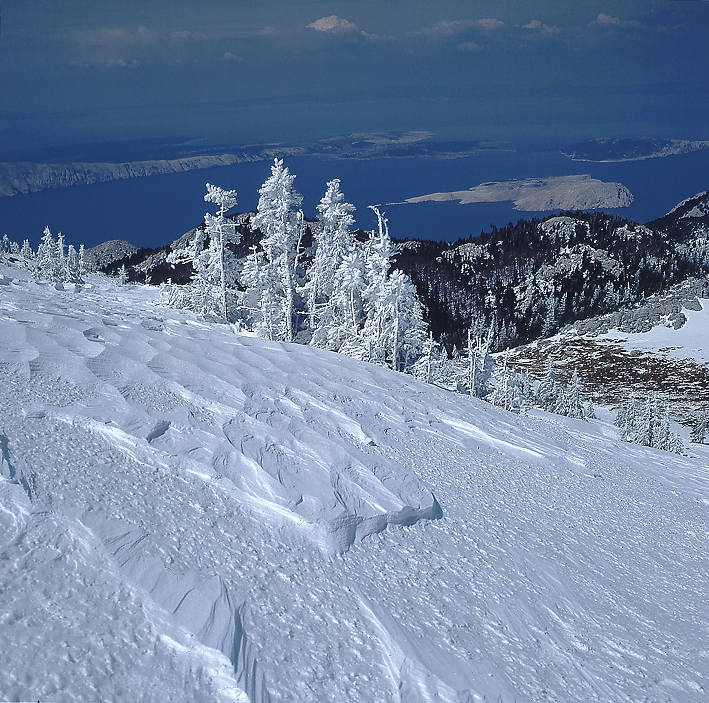
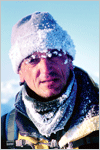
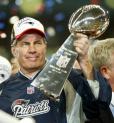
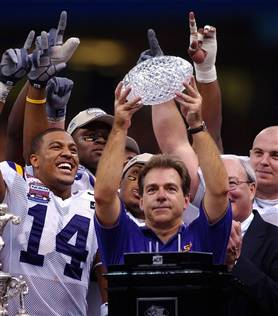
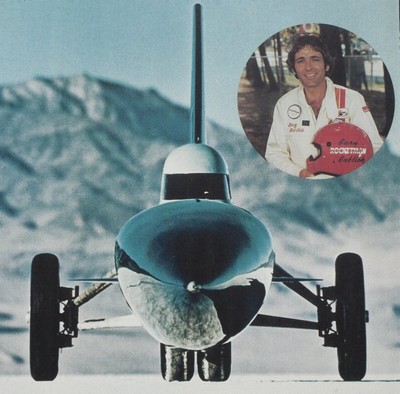
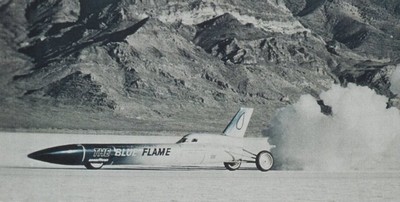
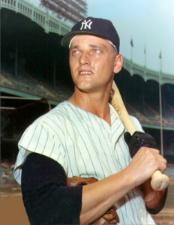
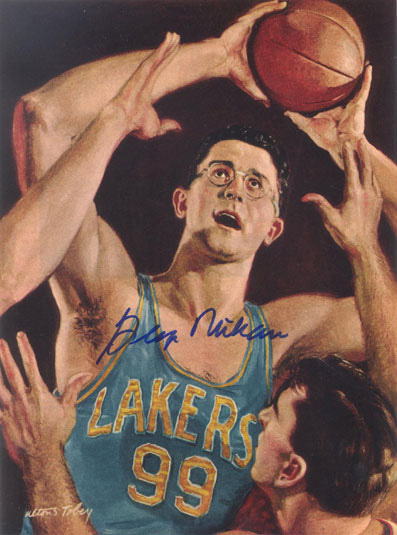
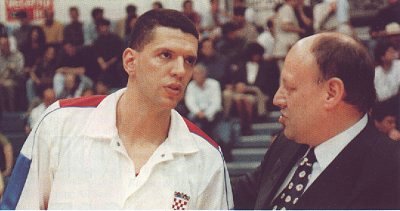

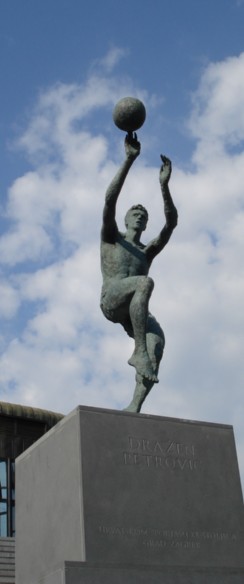
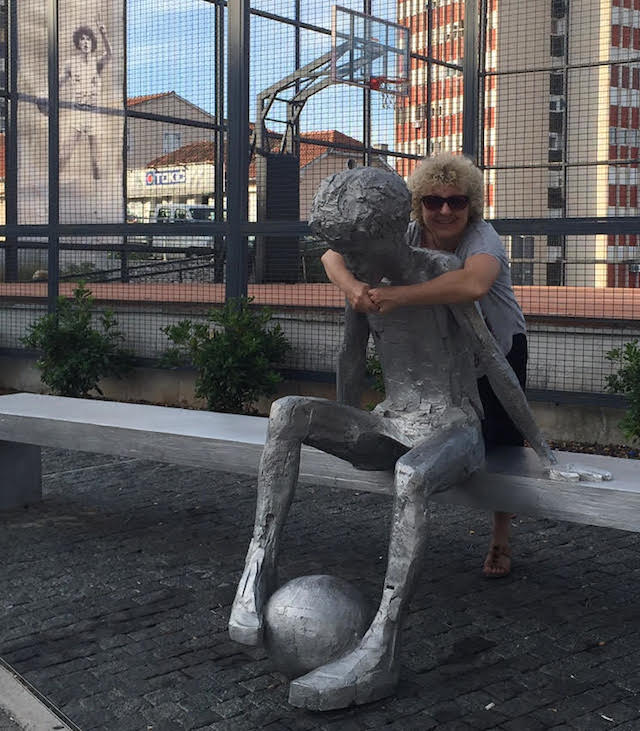
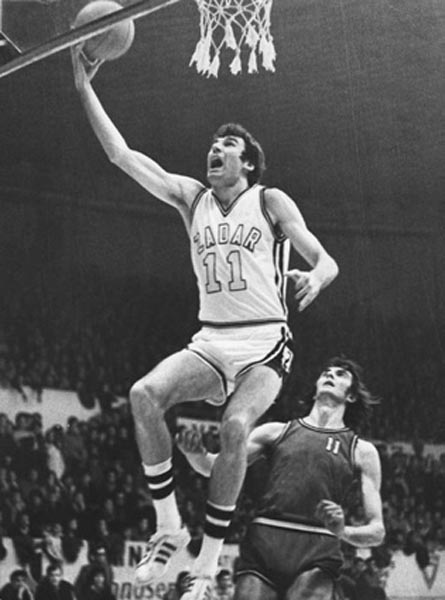
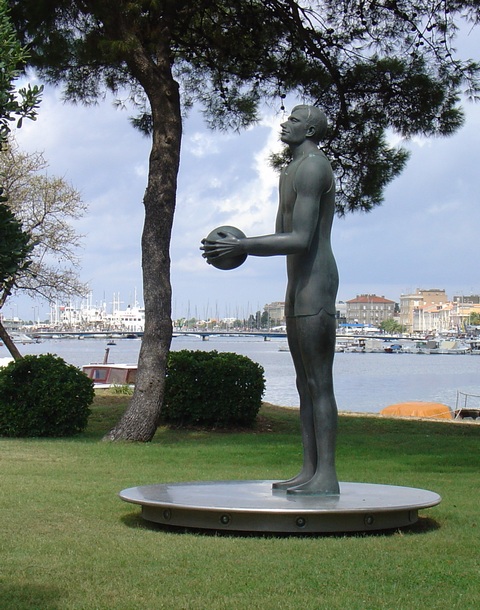

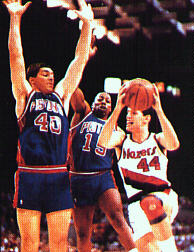
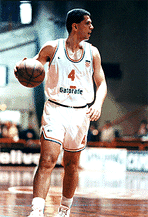
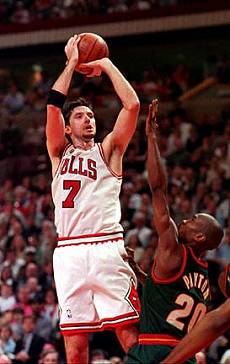
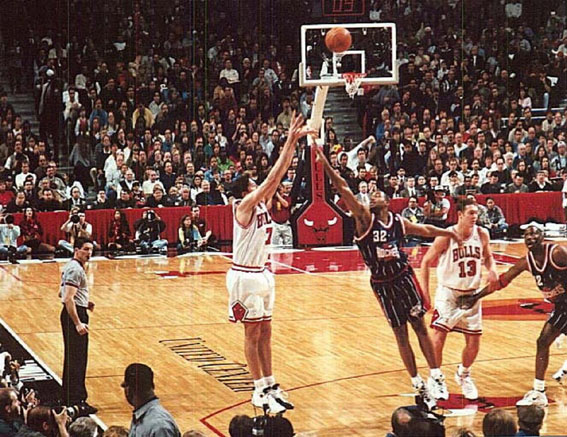
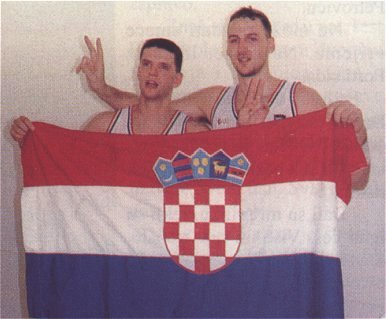
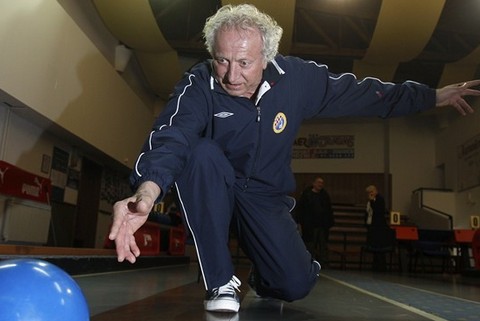
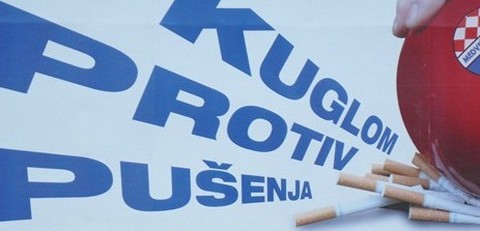
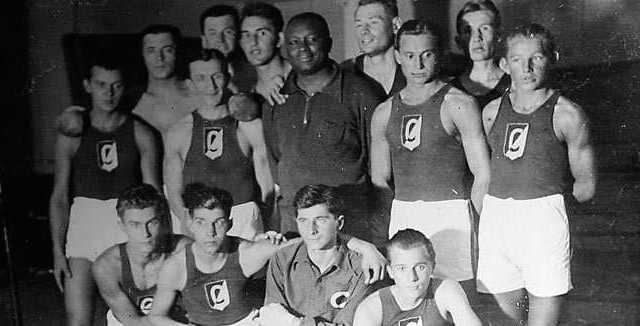
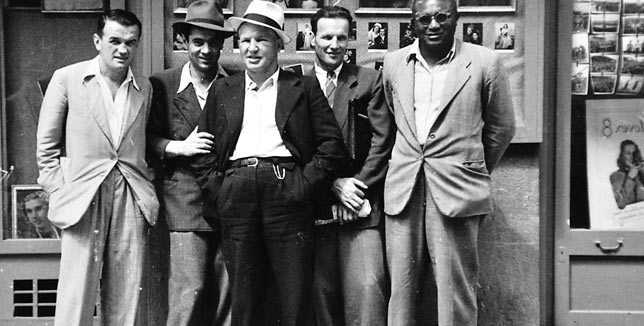
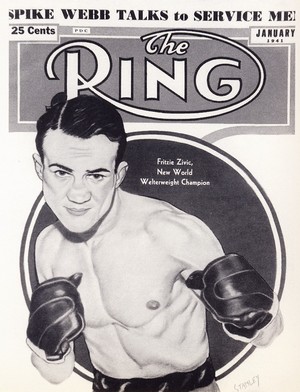
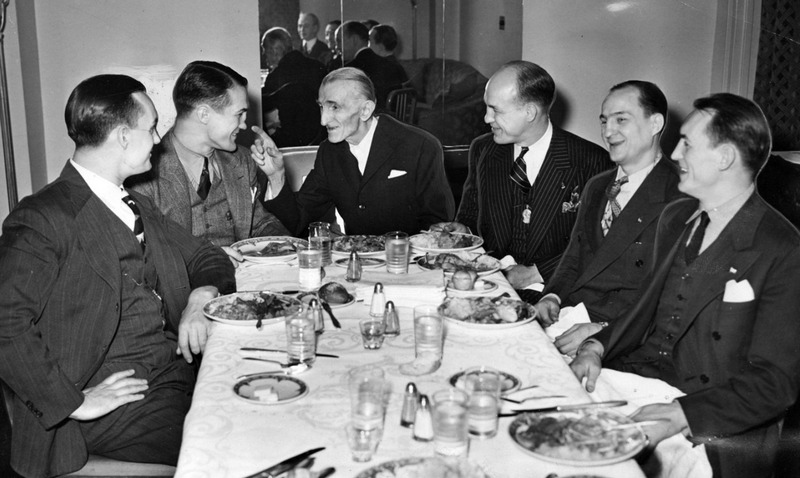 In
1941
In
1941